Every tech conversation these days includes someone saying:
“We’re using AI.”
And someone else replying:
“That’s amazing! …but what exactly do you mean?”
Because somewhere between AI, ML, neural networks, and GenAI, most people quietly get lost.
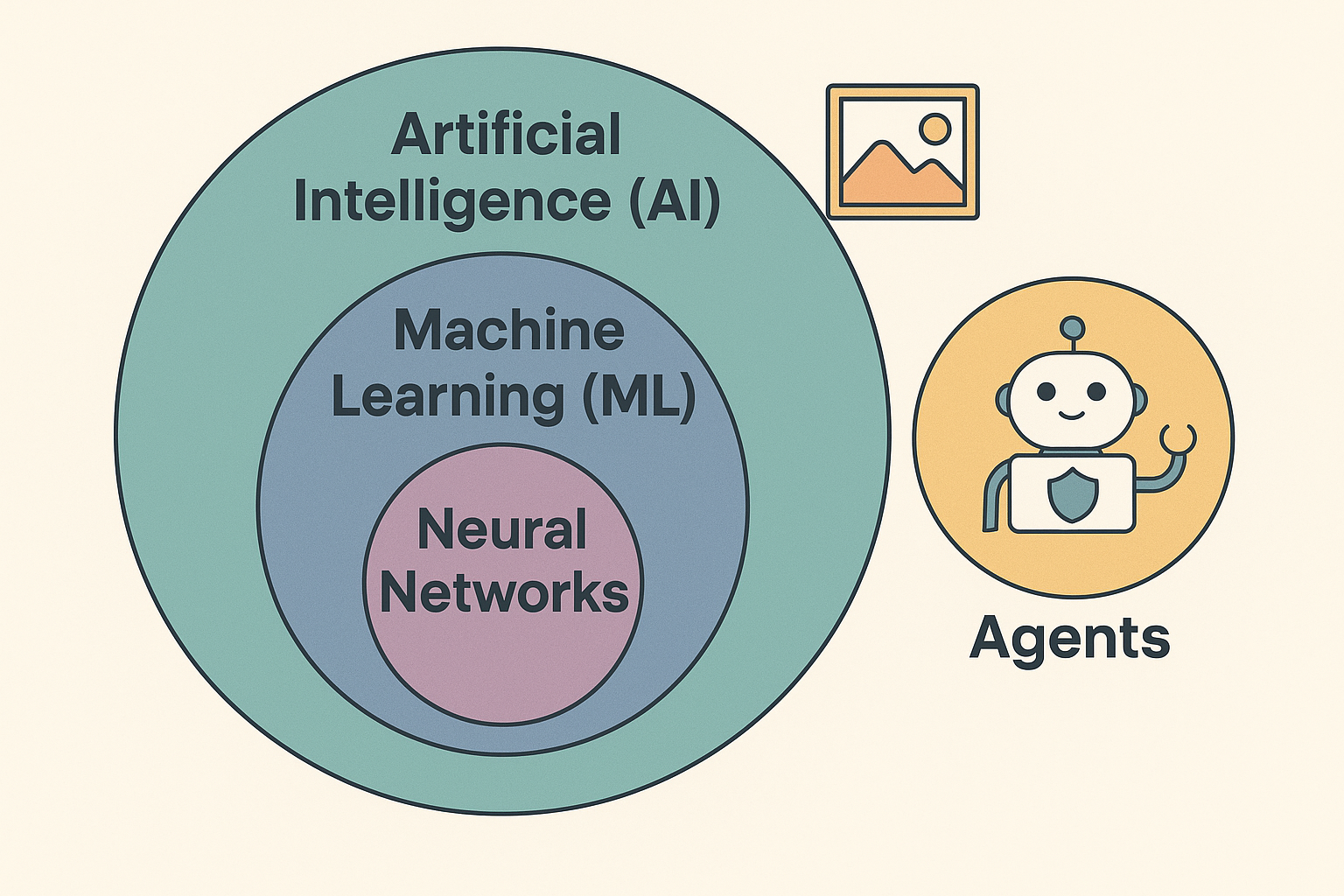
Let’s fix that — simply, clearly, and with a diagram your boss might actually understand.
🧠 Step 1: Artificial Intelligence (AI)
AI is the big umbrella — any system that tries to do something intelligent that humans normally do.
That could mean:
- Chess engines (1980s AI)
- Voice assistants
- Fraud detection systems
- Chatbots and self-driving cars
If it acts smart, it counts.
AI is the goal — making machines think (or at least act like they do).
🔢 Step 2: Machine Learning (ML)
Machine Learning is how we teach machines to act smart — not with hard-coded rules, but by learning from data.
Instead of telling the computer,
“If X, then Y,”
we give it 100,000 examples of X and Y and let it figure out the relationship.
It’s like showing instead of telling — except you don’t need snacks or small talk.
AI is the goal.
ML is the method that gets us there.
🧩 Step 3: Neural Networks (The Engine Room)
Neural Networks are a special type of machine learning — inspired (loosely) by how the brain works.
They consist of layers of “neurons” that pass numbers to each other, adjusting how much each input matters.
Over time, these layers learn patterns that make predictions smarter.
They power almost everything modern — image recognition, voice assistants, ChatGPT, and even those "AI" toasters.
Neural Networks = ML on turbo mode.
🎨 Step 4: Generative AI (GenAI)
This is where things get creative.
Generative AI doesn’t just analyze data — it creates it.
It writes text, paints art, generates code, composes music, and occasionally hallucinates your resume.
How? By predicting what comes next —
the next word, pixel, or note — based on everything it’s ever seen.
GenAI = Neural Networks that make new stuff, not just recognize old stuff.
🤖 Step 5: AI Agents (The Doers)
If GenAI is about creativity, agents are about autonomy.
They don’t just produce — they decide.
They have memory, goals, and the ability to take action —
like calling APIs, searching the web, or running workflows on your behalf.
Example:
- A research agent that reads PDFs and drafts a summary.
- A coding agent that writes, tests, and deploys code while you drink coffee.
Agents = AI that acts, not just talks.
⚙️ Step 6: Data & Training Pipelines (The Fuel)
Here’s what most people forget:
No data, no intelligence.
AI systems are only as good as the data that feeds them.
That means tons of behind-the-scenes work — cleaning, labeling, and retraining models to keep them fresh.
When people say “AI is powerful”, what they really mean is:
“Our data janitors deserve a raise.”
If AI is the brain, data is the diet.
And most AIs are only as healthy as what they eat.
🔄 Step 7: Reinforcement Learning (The Feedback Loop)
Now that the AI is trained, how does it keep improving?
Enter Reinforcement Learning — teaching through trial and reward.
The model tries something, gets feedback (“good bot” or “bad bot”), and adjusts.
Do this a few million times, and you get a system that can play chess, drive cars, or politely say,
“I’m sorry, I can’t help with that request.”
Humans learn the same way — except we call it performance reviews.
Reinforcement Learning = AI learning from consequences, not just data.
🧠 Step 8: Multimodal AI (The Next Frontier)
Today’s AIs mostly deal with one kind of data at a time — text, or images, or sound.
But the next generation? Multimodal AI — systems that can do all of it.
They can see, read, listen, and respond holistically.
Like describing a photo, summarizing a document, or understanding sarcasm in a video (still a work in progress).
Multimodal AI = the moment machines start experiencing the world more like we do.
🪄 The Big Picture
Here’s how it all fits together — from the biggest idea to the newest frontier:
AI is the universe.
ML is a planet.
Neural networks are cities.
GenAI is the creative district.
Agents are the citizens.
Data is the oxygen.
Reinforcement learning is evolution.
And multimodal AI — that’s the future skyline.
💡 The Takeaway
- AI is the dream — making machines think.
- ML is the discipline — learning from data.
- Neural networks are the engine — pattern recognition at scale.
- GenAI is creativity — generating new ideas.
- Agents are action — doing work autonomously.
- Data is the fuel — the foundation of intelligence.
- Reinforcement learning is growth — feedback that shapes behavior.
- Multimodal AI is the next evolution — seeing the world as a whole.
So the next time someone says,
“We’re building an AI platform,”
you can smile and ask,
“Cool — which layer of the universe are we talking about?”
🧭 AI is the dream.
ML is the discipline.
GenAI is the art.
Agents are the action.
And data — that’s the heartbeat.