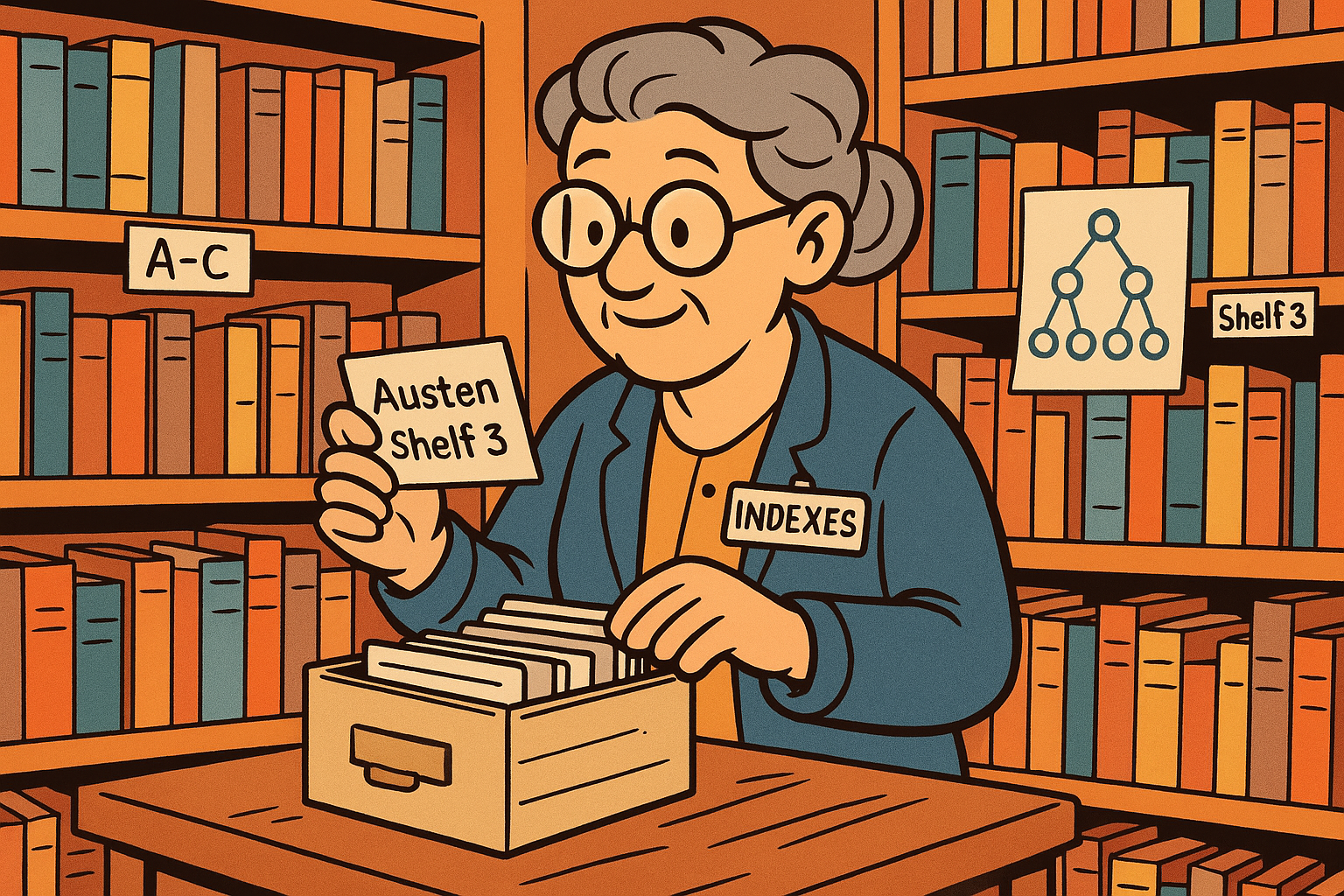
Every database has a secret librarian.
You don’t see them, but they’re in there — quietly cataloging everything,
remembering where things are,
and sighing every time you SELECT * without a WHERE clause.
This story is about them.
📚 Once Upon a Query
Imagine a giant library — millions of books, no catalog.
You walk in and ask the librarian:
“Can you find all books where the author’s name starts with A?”
The librarian nods, walks into the stacks, and starts reading.
Every. Single. Book.
That’s a full table scan.
And yes — your database cries a little every time it happens.
🗂️ Enter the Index
One day, the librarian decides to build a card catalog.
Now each card lists:
- The author’s name
- The shelf where the book lives
Next time someone asks for “Austen,”
they just flip through the catalog —
no need to read the entire library.
That’s an index.
🌳 How B-Trees Keep It All in Order
Most databases use something called a B-tree index (balanced tree).
Think of it as a hierarchical catalog:
- The root points to the right branch (by range of names).
- Each branch points to smaller groups (subsections).
- The leaves finally point to the actual records.
It’s like a multi-level table of contents:
“Authors A–C → shelf 1 → page 34 → record 1024.”
No matter how big the dataset gets,
the search time grows logarithmically — not linearly.
In human terms:
“Still fast, even when the library triples in size.”
🔍 Why Updates Get Slower
Now, imagine someone adds a new book.
The librarian has to:
- Put the book on the right shelf
- Update the catalog
That second step takes time.
That’s why inserts, updates, and deletes can slow down with too many indexes.
More indexes = more catalogs to keep up to date.
It’s like filing the same new book under “Romance,” “Historical,” and “19th Century” — every single time.
⚙️ Not All Indexes Are Trees
Different libraries, different systems.
🌳 B-tree Index
For sorted data — perfect for range queries.
WHERE salary BETWEEN 100000 AND 200000;
⚡ Hash Index
For exact matches — lightning fast for equality lookups.
WHERE user_id = 12345;
But useless for ranges.
(It’s like knowing someone’s locker number but not their floor.)
🧾 Inverted Index
Used in search engines — maps words → documents.
That’s how databases handle text search:
“Show me all emails containing the word urgent.”
🧮 Bitmap Index
For analytics — works great when the field has few unique values, such as:
“Gender = M/F” or “Status = Active/Inactive.”
Like marking which checkboxes each row belongs to.
💡 The Indexing Paradox
Indexes make reads fast but writes slower.
They take space.
They need maintenance.
And yet, we can’t live without them —
because without indexes, queries turn into epic adventures of pain.
So, like all good engineering trade-offs, it’s about balance.
Index what matters.
Measure what changes.
And never build one just because it sounds smart.
🧠 The Moral
In the end, your database isn’t a machine —
it’s a librarian doing its best to stay organized.
You can help them by:
- Asking clear questions (
WHEREis your friend) - Giving them a useful index (not ten redundant ones)
- Cleaning up outdated catalogs (drop unused indexes)
Because good indexing isn’t about speed —
it’s about respecting the librarian inside your database.
📘 Indexes don’t make your database smarter — they just remind it where it put things.