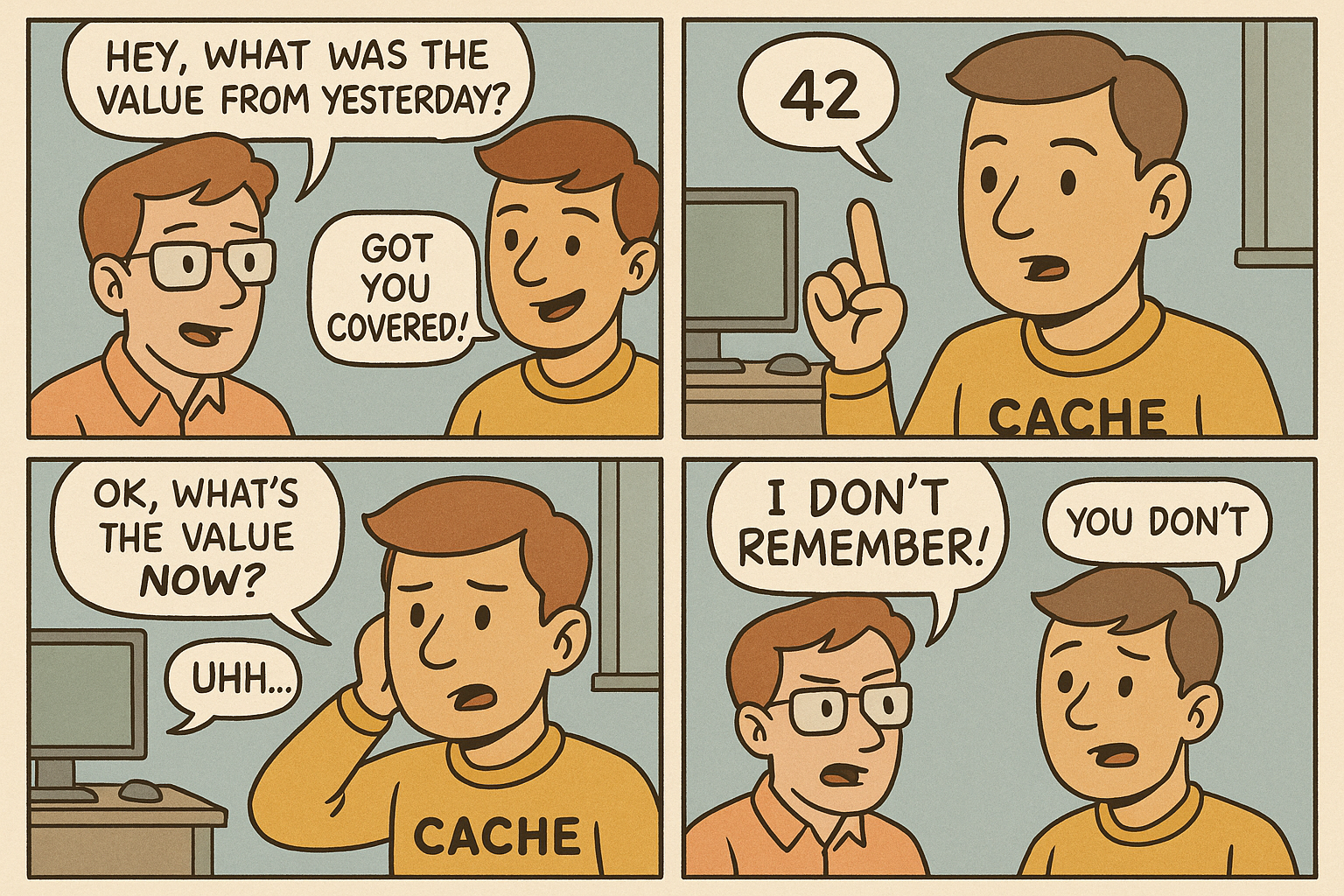
Everyone loves caching — until it ruins your day.
It’s the enthusiastic friend who remembers everything you told them last week but blanks out at your birthday dinner.
Fast, helpful, confident… and occasionally, utterly wrong.
🧠 The Cache Personality
Caching is basically your system’s short-term memory.
When it works, it’s magical: instant responses, happy users, servers sipping coffee in peace.
But like that one friend who confidently remembers your Wi-Fi password from 2019 — caching’s memory can be dangerous when it’s outdated.
“Oh yeah, I know that value!”
— Cache, seconds before serving stale data.
🎯 Cache Hits and Misses: The Gossip Game
Let’s imagine your app as a group chat.
-
Cache Hit:
Someone asks a question, and your friend blurts out the answer immediately.
Quick, efficient, slightly smug. -
Cache Miss:
The friend goes silent. You sigh and look it up yourself (database call).
Slower, but accurate. -
Stale Read:
The friend thinks they remember, but they’re wrong.
“No, no, the sale is still live!” they insist — hours after it ended.
🕰️ The TTL Dilemma: When to Forget
To avoid becoming that friend, caches use a TTL (Time-To-Live).
It’s like an expiry date for memory.
Too short, and you’re constantly re-fetching data.
Too long, and you’re confidently wrong for hours.
Finding the right TTL is like dating in your 30s — it’s all about commitment issues.
🔁 Cache Invalidation: The Hardest Problem in Computer Science™
You’ve probably heard this famous quote:
“There are only two hard things in Computer Science: cache invalidation and naming things.”
— Phil Karlton, probably while debugging Redis.
Cache invalidation is when you tell your cache,
“Forget everything you know about this. It’s outdated now.”
But caches, like humans, don’t always forget gracefully.
Sometimes they cling to stale data like it’s emotional baggage.
⚙️ Strategies to Keep the Friendship Healthy
-
Write-Through Cache:
Every time you write to the DB, you also update the cache.
✅ Always fresh, but adds latency. -
Write-Behind Cache:
Write to the cache first, and let it update the DB later.
⚡ Fast, but dangerous — like texting before thinking. -
Cache-Aside (Lazy Loading):
Only read from DB when needed, then cache the result.
🧘♂️ Simple, balanced, and the most common approach. -
Invalidate Smartly:
Don’t nuke the entire cache — evict selectively.
Or you’ll be explaining to your boss why the homepage loaded like a 2005 blog.
🧩 Distributed Cache: The Group Chat Problem
In large systems, you don’t just have one cache — you have many.
They don’t always agree.
- Node A says “user is active.”
- Node B says “user logged out.”
- Node C says “who even is this user?”
Welcome to the world of eventual consistency, where truth is more of a suggestion.
💡 The Moral of the Story
Caching isn’t about remembering everything.
It’s about remembering the right things, for the right amount of time.
- Don’t trust memory without context.
- Don’t rely on speed without truth.
- And always give your cache a way to say, “Wait, let me check.”
Because fast and wrong is still wrong — just sooner.
🧱 Caching: proof that remembering everything isn’t the same as understanding anything.