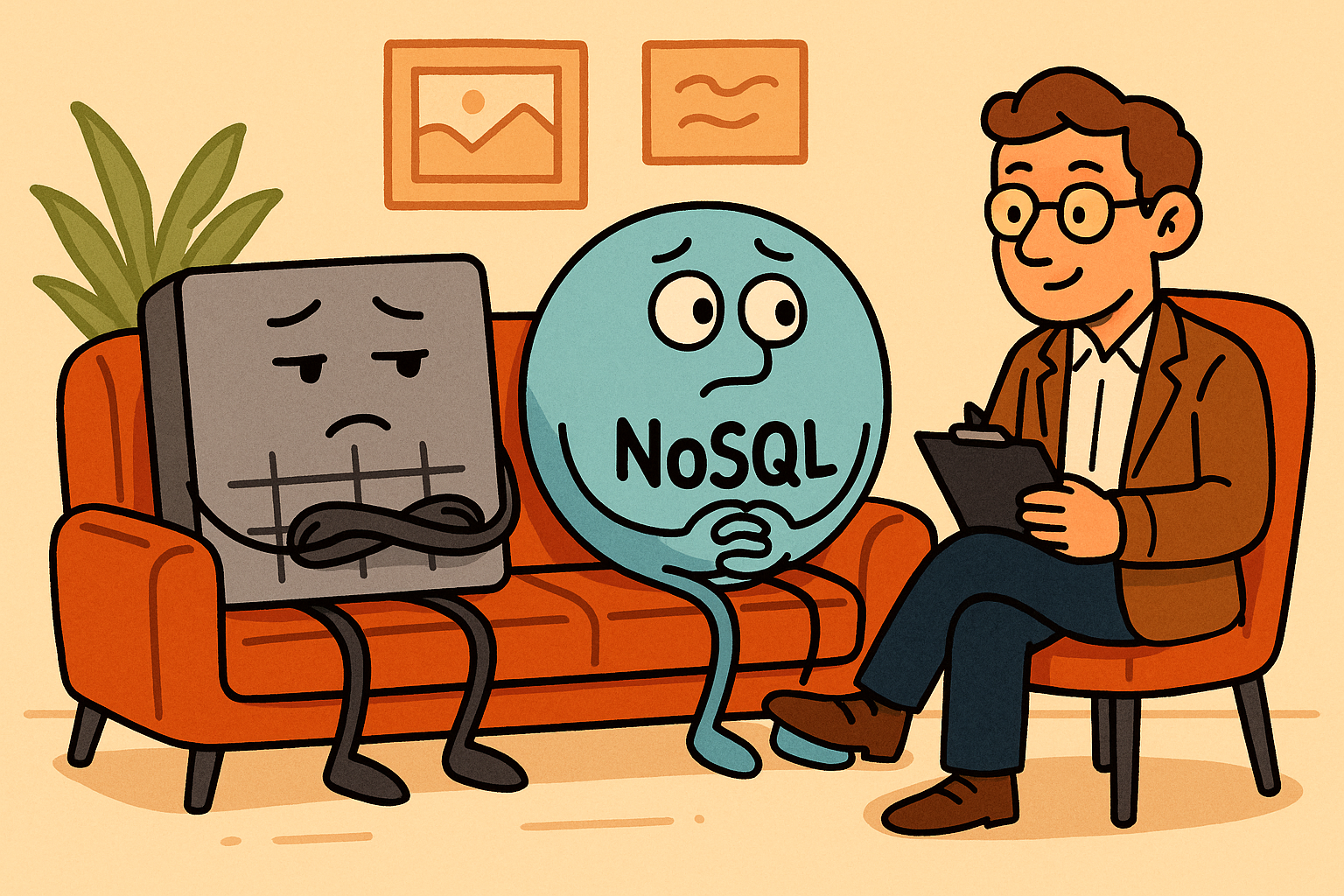
It was supposed to be a normal session.
Two databases, one couch, and a very patient therapist.
On the left sat Relational — punctual, rule-following, schema-loving.
On the right sat NoSQL — flexible, spontaneous, and proudly schema-free.
They’d been in production together for years, but lately… things just weren’t scaling the way they used to.
💔 The Opening Scene
Therapist: “So, what seems to be the problem?”
Relational: “They never commit! We used to have transactions. Atomic ones. Everything was ACID — now it’s all BASE!”
NoSQL: “Oh please. You’re obsessed with structure. You need every relationship defined before it even exists. I just want to store documents and breathe.”
Therapist: “Okay, okay. Let’s take a deep breath — maybe even a full-table scan.”
🧠 The Backstory
It all started years ago.
Relational had a perfect system:
- Tables.
- Foreign keys.
- Joins that tied everything neatly together.
Every query was predictable. Every relationship defined.
Everything was consistent — and that was comforting.
Then came scale. And users. And JSON.
⚡ The Disruption
When the app started growing, relational just couldn’t keep up.
Every schema change required a migration, every join slowed down under pressure.
That’s when NoSQL showed up — fast, easy, scalable, and allergic to structure.
NoSQL: “You don’t need tables for everything! Just throw it in a document!”
Relational: “But what about referential integrity?”
NoSQL: “Referential what now?”
They had chemistry — but zero consistency.
⚖️ The Therapy Session
Therapist: “Let’s talk about your communication patterns. What happens when things get out of sync?”
Relational: “I lock the table. It’s safer that way.”
NoSQL: “You lock the table? I just let it go eventually.”
Therapist: “Ah. So you’re ACID and you’re BASE.”
Relational: “Exactly. I’m Atomic, Consistent, Isolated, Durable.”
NoSQL: “And I’m Basically Available, Soft-state, Eventually consistent.”
Therapist: “So… one of you is a perfectionist, and the other’s a free spirit.”
Both nodded, silently agreeing that this was, in fact, the problem.
🧩 The Realization
After hours of arguing about joins and sharding, they realized something profound:
They weren’t opposites.
They were complementary.
Relational was dependable, structured, great for transactions.
NoSQL was flexible, scalable, perfect for unstructured chaos.
They didn’t need to compete — they just needed boundaries.
Literally. Bounded contexts.
☕ The Compromise
They agreed on a healthy hybrid relationship:
- Relational would handle core transactions, where integrity mattered most.
- NoSQL would handle analytics, sessions, logs, and scale, where flexibility ruled.
- They’d sync occasionally — through APIs, streams, or event buses.
It wasn’t perfect. But it was real.
💡 The Lesson
In the end, they both learned something important:
- Structure is comforting.
- Flexibility is freeing.
- Balance is everything.
You don’t have to choose between order and chaos.
Because great architecture — like great relationships — thrives on both.
🧩 Some databases scale with rules. Others scale with trust. The best systems? They scale with understanding.