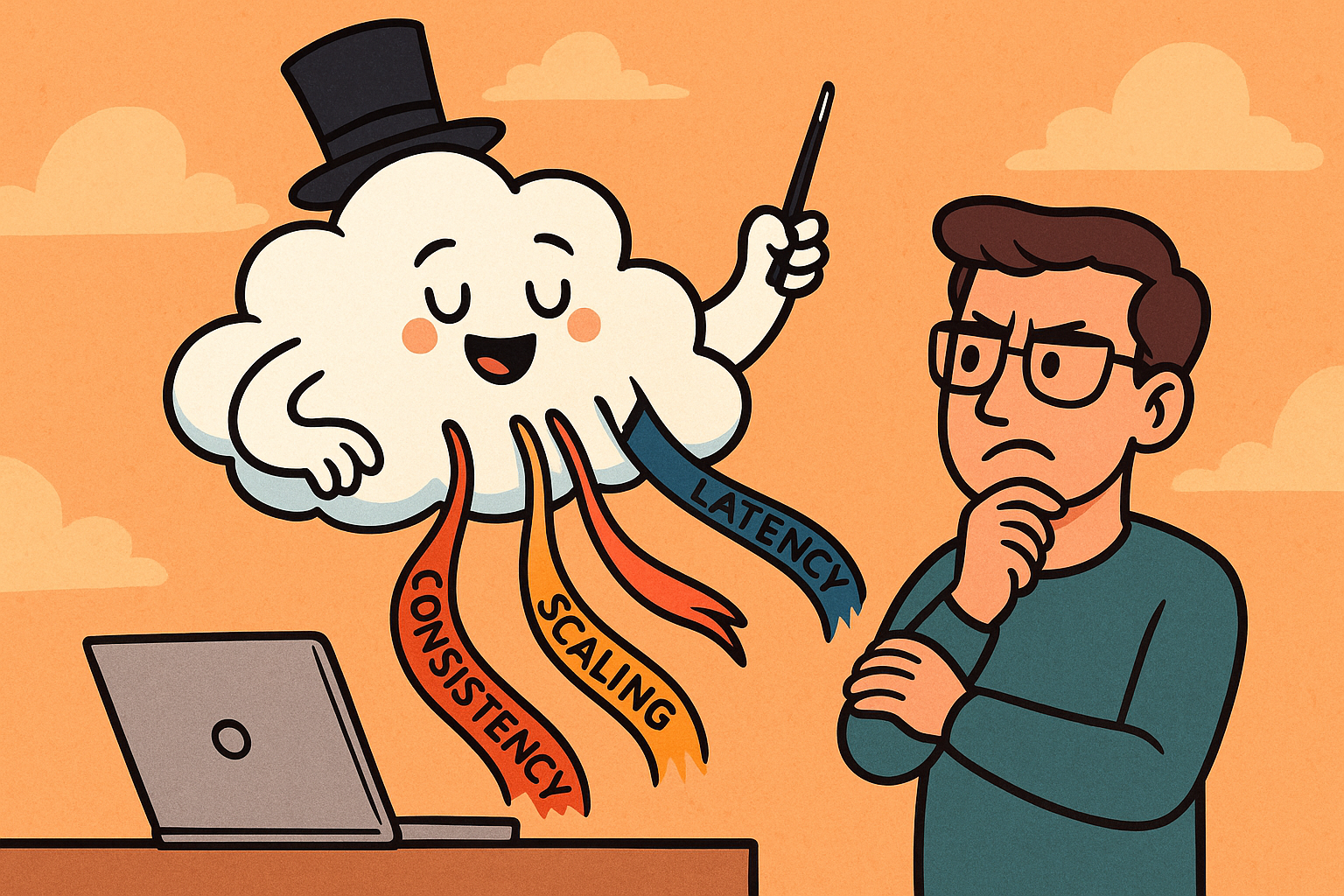
You spin up an EC2 instance,
attach an autoscaling group,
set a load balancer in front,
and voilà — your app can handle a billion users.
So why, you wonder, are interviewers still asking about consistent hashing, leader election, and the CAP theorem?
Didn’t the cloud solve all that already?
☁️ The Illusion of Simplicity
Modern cloud providers have made infrastructure feel like magic.
Need scaling? Toggle “Auto.”
Need storage? aws s3 sync . s3://my-bucket and you’re done.
Need a distributed cache? aws elasticache create and go for lunch.
It’s tempting to think we’ve moved beyond distributed systems.
But here’s the catch:
The cloud didn’t remove complexity.
It just moved it a few layers higher.
Now you’re not fighting with servers — you’re fighting with services.
And every one of those services is a distributed system wearing a friendly API.
🧠 Why Distributed Thinking Still Matters
Imagine debugging this:
- Your app runs on AWS Lambda.
- You’re using DynamoDB for data.
- Half your requests suddenly time out in
us-east-1.
The docs say “eventual consistency.”
The logs say “throttled.”
Your PM says “fix it.”
At that moment, you don’t need to know how to implement Raft.
You need to understand why data replication behaves this way —
and how to design for it.
That’s distributed reasoning — and no amount of serverless.yml can replace it.
💡 What the Cloud Actually Does (and Hides)
When you deploy to AWS, you’re standing on top of thousands of distributed algorithms:
| Concept | Cloud Example | Hidden Truth |
|---|---|---|
| Load Balancing | ALB / NLB | Uses hashing + consistent routing under the hood |
| Storage Scaling | S3, DynamoDB | Data partitioning + replication |
| Autoscaling | EC2, Lambda | Capacity prediction + feedback loops |
| Resilience | Multi-AZ & Regions | Leader election + quorum decisions |
| Caching | CloudFront, Redis | Sharding + invalidation |
| Queues & Streams | SQS, Kinesis | Ordering guarantees + checkpointing |
The magic only feels simple because engineers you’ll never meet are sweating the hard parts — the same ones you’re being asked about in interviews.
🎓 Why Big Companies Still Ask Those Questions
Companies like Meta, Google, or Netflix don’t ask:
“How would you implement consistent hashing?”
because they expect you to code it from scratch.
They ask because they want to see how you think:
- Do you understand what problem consistent hashing solves?
- Can you reason about scaling when new nodes join?
- Can you make trade-offs between consistency and availability?
It’s not about implementation — it’s about intuition.
They’re testing if you can think like a system,
not just deploy one.
⚙️ When Abstractions Leak
Here’s the uncomfortable truth:
every abstraction leaks — especially at scale.
At 10 users, you don’t notice.
At 10 million, you do.
Examples:
- Your autoscaling group overreacts and oscillates.
- Your region fails, and “eventual” consistency becomes “never.”
- Your queue retries endlessly because your downstream API isn’t idempotent.
Understanding distributed systems isn’t about building infrastructure —
it’s about knowing why things break the way they do.
🌩️ Cloud vs. Fundamentals
Let’s compare the two mindsets:
| Cloud-Native Thinking | Distributed Thinking |
|---|---|
| “AWS handles that.” | “What does AWS actually do to handle that?” |
| “We’ll just scale horizontally.” | “How does data stay balanced when we scale?” |
| “We use managed Kafka.” | “What’s Kafka doing with partitions and leaders under the hood?” |
| “It’s serverless.” | “It’s still running on servers, right?” |
The cloud gives you tools.
Distributed systems give you understanding.
And understanding doesn’t go out of fashion.
🪞 A Small Reality Check
You don’t need to write your own consensus algorithm.
You don’t need to handcraft a distributed cache.
But you do need to recognize what’s happening when things go wrong —
because that’s when all those elegant AWS diagrams turn into mystery art.
When you understand the fundamentals:
- “Autoscaling anomalies” become control loop delays.
- “Cache evictions” become stale data consistency trade-offs.
- “Regional failovers” become quorum decisions in disguise.
🧭 The Takeaway
The cloud is a distributed system — you’re just renting someone else’s complexity.
So yes, AWS handles scaling.
But when that scaling breaks, the person who understands how distributed systems think
is still the one everyone calls into the war room.
☁️ You don’t need to build distributed systems anymore.
You just need to understand them well enough to survive inside one.