It began on a quiet Tuesday.
Traffic was steady, logs were green, dashboards calm.
And then — one small timeout triggered a chain reaction that would make disaster movies look subtle.
🌩️ Act I: The First Timeout
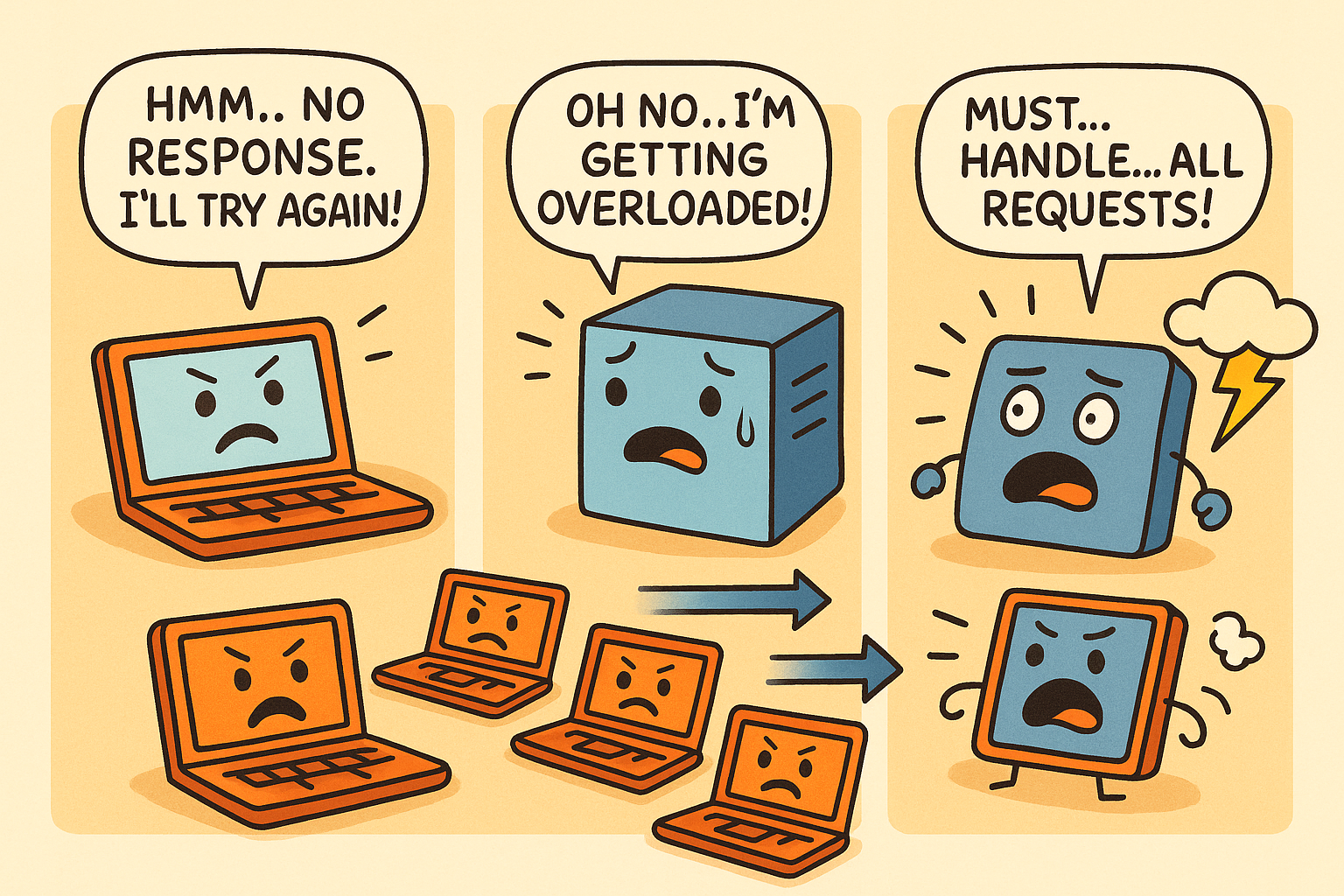
Somewhere in the cloud, a client made a simple API call.
It waited… a few milliseconds too long.
“Hmm, must be the network,” the client thought.
“I’ll just retry. Once. Maybe twice.”
Harmless, right?
Except a thousand other clients thought the same thing.
Now the server, already under pressure, got double the requests — each retrying like a toddler insisting,
“Did you hear me? Did you hear me now?”
🔥 Act II: The Storm Forms
Soon, retries piled on retries.
The server, gasping for breath, started timing out more often.
Clients panicked.
They retried again. And again. And again.
Congratulations — you’ve just witnessed the birth of a Retry Storm.
A self-inflicted distributed denial of service (DDoS).
No hackers. No bad actors.
Just polite, well-meaning software… gone feral.
⚙️ Act III: When Good Clients Go Bad
Let’s pause the chaos for a quick breakdown.
What’s really happening here?
- Retry logic is meant to handle temporary failures gracefully.
- But without limits, jitter, or backoff, those retries stack up like a feedback loop.
- The result? The server never recovers — because clients keep attacking it with love.
It’s like 100 people shouting “Are you okay?” at someone who just fainted.
🧠 Act IV: Enter Idempotency — The Hero We Deserve
If retries are inevitable, we need a system that doesn’t panic when they happen.
That’s where idempotency comes in.
An idempotent operation can run multiple times and still have the same effect.
Example:
- Charging a customer twice for the same payment = ❌
- Charging once, but safely retrying if confirmation failed = ✅
It’s the digital version of saying:
“If I already did this, I won’t do it again — promise.”
⏳ Act V: Exponential Backoff — The Art of Waiting Gracefully
Now let’s talk backoff — not as a threat, but as a life skill.
Instead of retrying immediately (and making things worse), clients should wait a little longer each time.
For example:
- Retry after 1 second.
- Then 2 seconds.
- Then 4, 8, 16…
Add a bit of random jitter so everyone doesn’t retry in sync, and you’ve turned chaos into choreography.
“Patience,” said every successful distributed system ever.
🧩 Act VI: Fault Isolation — Because Firewalls Aren’t Just for Hackers
When one service starts misbehaving, it shouldn’t take the entire system down with it.
That’s why we build circuit breakers, bulkheads, and timeouts.
- Circuit breaker: stop calling a failing service temporarily.
- Bulkhead: isolate resources so one failure doesn’t flood others.
- Timeout: cut off calls that take too long before they spiral.
Together, these patterns keep your architecture resilient — even when the clients go rogue.
🌤️ Act VII: The Calm After the Storm
Eventually, the engineers rolled out fixes:
- Exponential backoff.
- Idempotency keys.
- Circuit breakers.
- And a healthy fear of “just one more retry.”
The system recovered.
The logs went green again.
But the scars — and the PagerDuty nightmares — would remain forever.
💡 The Takeaway
- Retries are not evil. They’re essential.
- But unbounded retries are chaos disguised as optimism.
- Use idempotency, backoff, and fault isolation — or your system will lovingly destroy itself.
Because in the end, even good clients can go bad…
especially when they just can’t take “timeout” for an answer.
🛠️ Resilience isn’t about never failing.
It’s about failing politely, at reasonable intervals.