Once upon a time, in a data center not so far away,
there was a cluster of servers living happily together —
sharing keys, caching data, and serving requests in peace.
Until one day, someone added a new server.
And everything fell apart.
😬 The Problem Before the Circle
Imagine you’re running a cache cluster with 4 servers: A, B, C, D.
Each key (say, a user session) is assigned to a server using a simple formula:
server = hash(key) % 4
Beautifully simple.
Until you add one more server — E.
Now % 4 becomes % 5, and every single key gets a new hash.
Every cache entry? Gone.
Every request? A miss.
Every engineer? Panicking.
That’s called rehashing chaos —
where one tiny scaling change invalidates your entire cache.
It’s like reorganizing a library alphabetically by last name,
then deciding to include middle initials.
🌀 Enter Consistent Hashing
Then came a hero.
A simple idea that changed distributed systems forever:
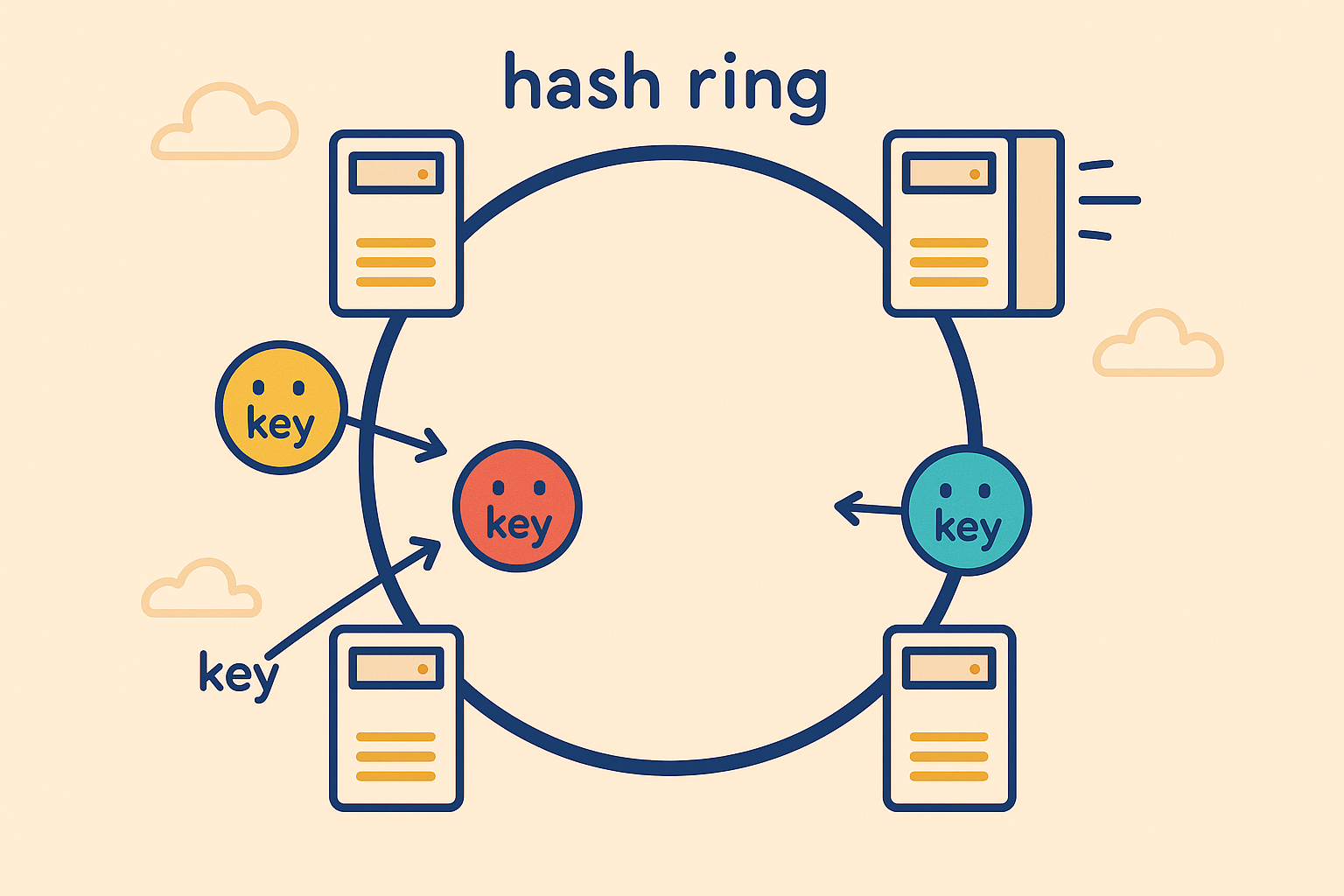
“What if the servers lived on a circle?”
Picture a ring — 0° to 360°.
Now, you hash both your servers and keys onto that same circle.
Each key belongs to the first server clockwise from its position.
Add a new server?
Only the keys that fall between it and its neighbor move.
Remove a server? Same deal.
The circle stays consistent.
The universe doesn’t collapse.
🎯 Why It Works
Consistent hashing solves the chaos of scaling:
- Minimal movement: Only a fraction of data changes placement when nodes change.
- Even distribution: Each server gets roughly the same amount of keys.
- Fault tolerance: Remove one node — others pick up the slack smoothly.
It’s like a round table dinner —
if one guest leaves, everyone just shifts over a little.
🔁 Virtual Nodes — The Secret Ingredient
In practice, not all servers are equal.
One has SSDs, another is running on emotional support and coffee.
To balance load better, we create virtual nodes —
multiple positions on the circle for the same physical server.
Example:
- Server A gets 3 spots on the ring (A1, A2, A3).
- Server B gets 5.
- The hash function spreads them evenly.
Now load isn’t just fair — it’s flexible.
⚙️ Real-World Examples
You’ve seen consistent hashing in action even if you didn’t realize it:
- CDNs (Akamai, Cloudflare): deciding which edge server stores which content.
- Distributed Caches (Memcached, Redis Cluster): routing keys without breaking everything.
- Load Balancers & Databases: picking nodes predictably even as clusters scale.
It’s the unsung hero of “we added more servers and nothing exploded.”
💡 A Life Lesson from the Hash Ring
Consistent hashing isn’t just math.
It’s wisdom disguised as an algorithm.
When change happens, don’t reshuffle everything.
Just adjust what’s necessary and keep the circle intact.
Scalable systems — and people — stay stable
not because they avoid change,
but because they localize its impact.
🌀 The secret to distributed harmony:
Change little. Stay consistent. Keep the circle unbroken.