It started, as all tech tragedies do, with good intentions.
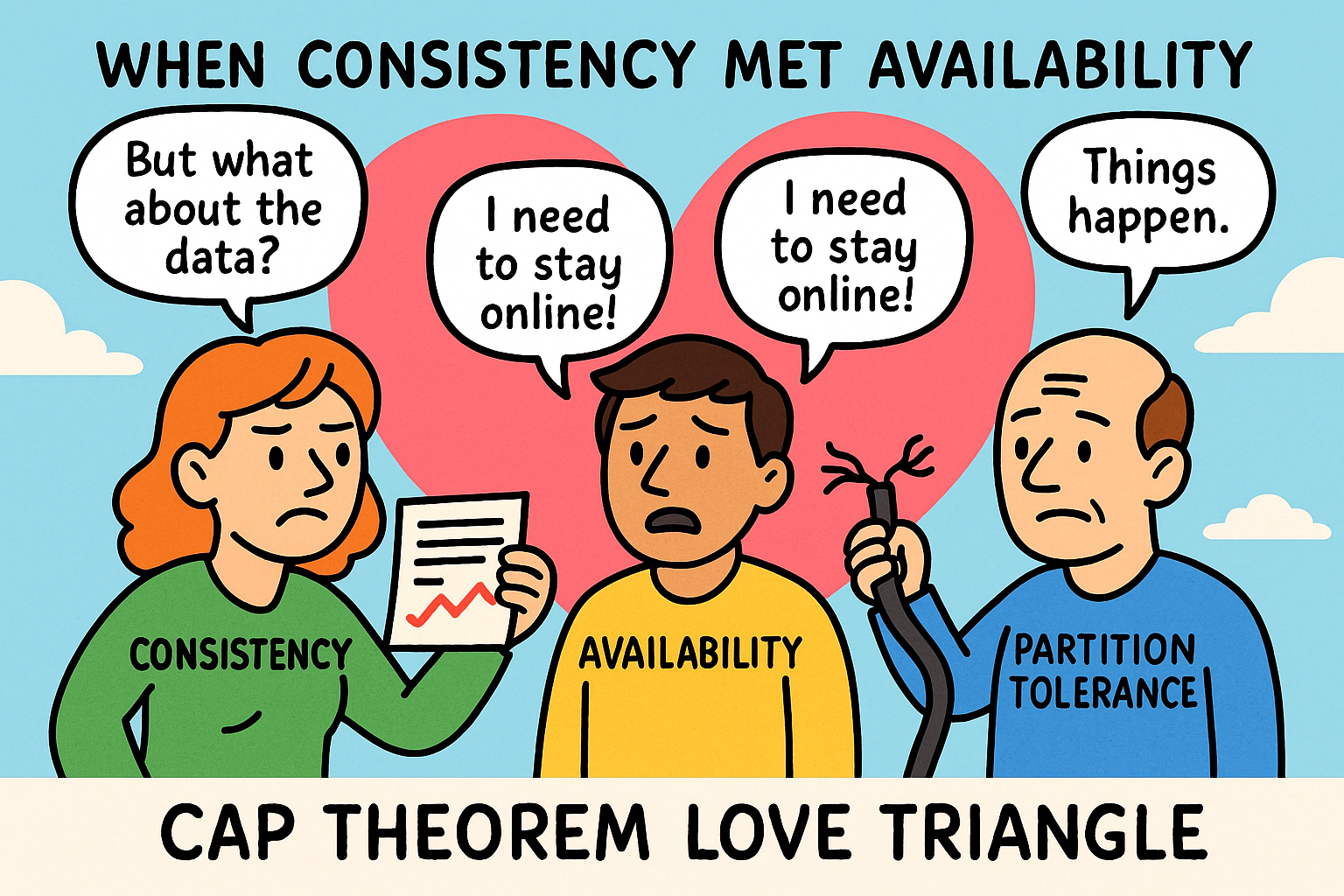
Three brilliant personalities walked into the same distributed system —
Consistency, Availability, and Partition Tolerance.
They were inseparable.
Until one fateful outage forced a choice.
💔 The Setup: The Perfect System
Back in the early days, everything was peaceful.
Data lived together in harmony, every node knew its place, and responses were instant.
Then one day — the network broke.
Messages got lost. Nodes stopped talking.
And the system realized: it couldn’t keep all three of its favorite things.
You can have Consistency.
You can have Availability.
You can survive Partitions.
But you can’t have all three — not at once.
Thus began the CAP Theorem — the most famous love triangle in computer science.
🧠 Meet the Trio
💅 Consistency — the perfectionist
She insists every node must agree before speaking.
“If one of us is wrong, none of us should answer.”
Elegant, reliable, but painfully slow in group decisions.
She’s the reason transactions don’t lie — and also why users wait.
☕ Availability — the people pleaser
He believes every request deserves a response — even if it’s mostly right.
“Better to say something than go silent.”
Always cheerful, never blocking, occasionally wrong.
Your app stays online because of him — and sometimes, so do your bugs.
🌩️ Partition Tolerance — the realist
The quiet one nobody invites until things go wrong.
“Look, networks fail. Deal with it.”
He ensures your system keeps working even when half of it vanishes into the cloud void.
The problem? When he’s around, Consistency and Availability start fighting.
⚖️ The Conflict
Everything was fine — until one day, a network partition hit.
The system had to choose.
- Stick with Consistency: wait for every node to agree, even if users stare at a spinning wheel.
- Or stay loyal to Availability: serve responses fast, even if some are slightly outdated.
In other words:
Do you want to be right, or do you want to be responsive?
💔 The Breakup
Consistency sighed.
“If we can’t all agree, then no one should answer.”
Availability frowned.
“If we don’t respond, users will leave. We’ll be perfect — but alone.”
Partition just shrugged.
“I told you this would happen.”
And so, every distributed system since has had to pick sides.
🏕️ Team CP vs. Team AP
-
Team CP (Consistency + Partition Tolerance):
Systems that value correctness over speed.
Examples: HBase, MongoDB (in some configs), ZooKeeper.
Great for banking, terrible for Instagram likes. -
Team AP (Availability + Partition Tolerance):
Systems that prioritize uptime over absolute accuracy.
Examples: Cassandra, DynamoDB, Couchbase.
Perfect for social media feeds — not your bank balance.
CP systems make you wait.
AP systems make you wonder.
💡 The Lesson
The CAP Theorem isn’t just a technical rule — it’s a life lesson:
you can’t optimize for everything.
Sometimes you must choose:
- Speed over precision.
- Access over accuracy.
- Progress over perfection.
Even in systems — and relationships — trade-offs define stability.
🧭 The Takeaway
- Consistency ensures truth.
- Availability ensures happiness.
- Partition Tolerance ensures survival.
You can’t have all three in a storm — so design knowing which one matters most.
Because in love and distributed systems…
It’s all fun and games until the network drops.
⏳ CAP Theorem: Proof that every system has commitment issues.