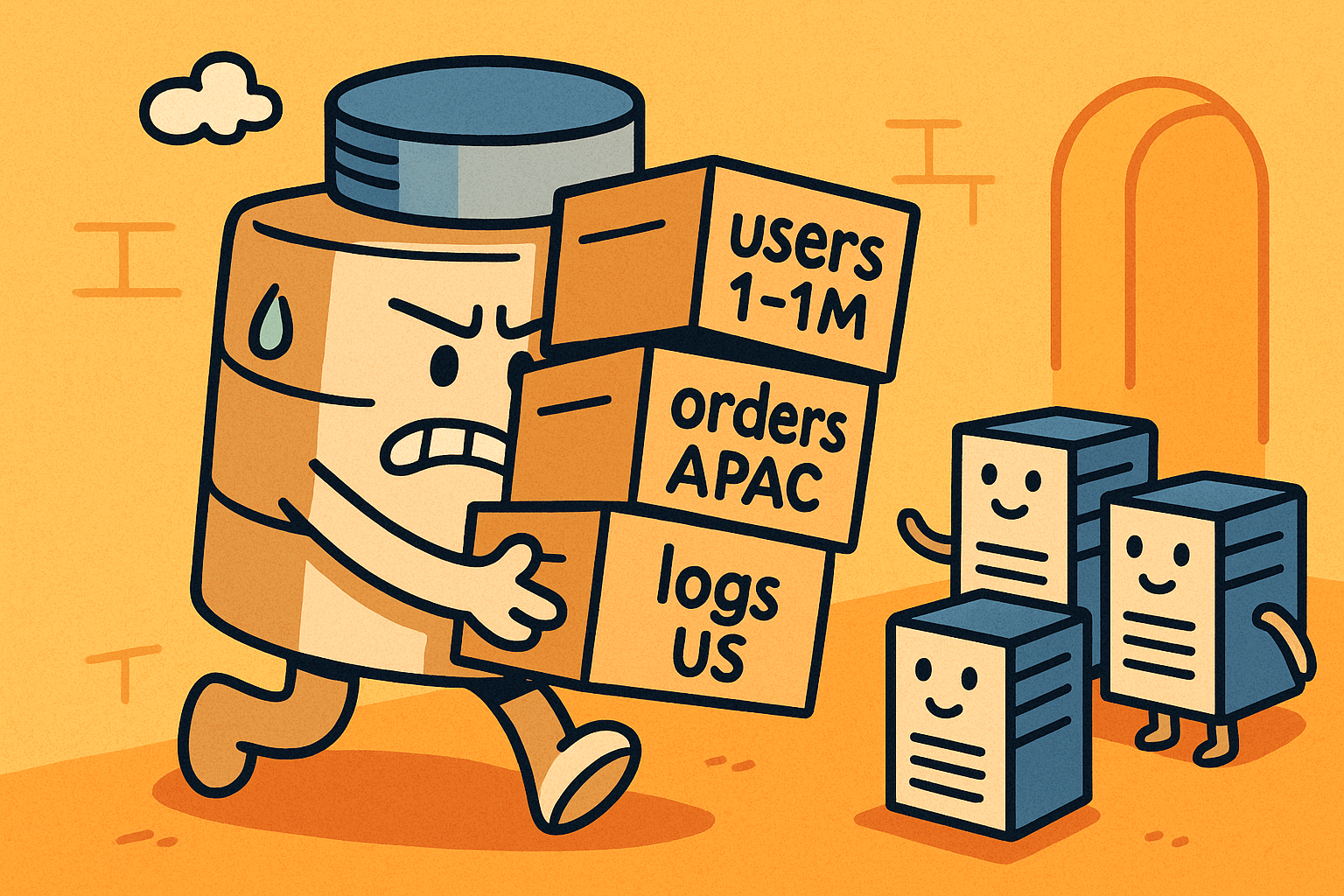
It started innocently.
A database, a single server, a cozy home for all the data in the world.
Then the users came.
Then their friends.
Then their cat pictures.
And before long, the database couldn’t even breathe between queries.
So it did what any overwhelmed tenant would do:
It rented a second apartment.
🏠 When One Database Isn’t Enough
At first, everything fits in one place —
one schema, one instance, one happy life.
But as the system grows, you start hitting limits:
- Queries slow down.
- Backups take forever.
- Disk space vanishes.
- And replication lag starts measuring in minutes.
Welcome to vertical scaling hell — the “just buy a bigger box” phase.
Until you realize boxes have limits, budgets have ceilings, and patience has expired.
So you do what scale demands: you split.
🧩 Enter Partitioning and Sharding
Let’s get the vocabulary straight.
🗂️ Partitioning
Partitioning means cutting one giant table into smaller, more manageable pieces — usually within the same database.
Think of it as organizing your closet:
- Shirts on one shelf,
- Pants on another,
- And socks (somehow) everywhere.
It’s still one closet — just better organized.
Common types:
- Range partitioning: user IDs 1–1M, 1M–2M, etc.
- List partitioning:
US,EU,APAC. - Hash partitioning: random but evenly spread.
🧳 Sharding
Sharding is when you outgrow even that single closet —
so you rent more apartments.
Each shard lives on a separate server or cluster,
holds its own subset of data,
and ideally doesn’t bother the others.
Example:
- Shard 1: Users 1–1M
- Shard 2: Users 1M–2M
- Shard 3: EU customers only
It’s horizontal scaling — more homes, less drama.
⚖️ The Trade-offs (a.k.a. The Rent Agreement)
🧭 The Good
- Scales horizontally: you just add more shards.
- Isolates failures: one shard can crash without killing the rest.
- Faster queries: smaller datasets mean smaller headaches.
⚡ The Bad
- Cross-shard queries: “Give me all users across shards” now means “start a distributed group project.”
- Rebalancing: moving data between shards = moving apartments mid-summer.
- Complexity: now you need a shard map or service to know where your data even lives.
🔥 The Hotspot Problem
It’s all fun and scale until one shard gets popular.
Imagine:
- You sharded by region.
- But all your traffic comes from North America.
Congratulations — one shard is now on fire while the others play chess.
That’s why many systems use consistent hashing —
to spread load evenly,
and to make adding new shards slightly less painful.
📡 How Real Systems Handle It
- Twitter: shards by user ID ranges — no one tweet storms another’s shard.
- MongoDB / Cassandra: built-in shard support with smart routing.
- Stripe / Shopify: shard by merchant or customer — each tenant lives in its own logical home.
- Old startups: manual shard maps, duct tape, and prayer.
🧠 Lessons from the Great Migration
Eventually, your system looks like a sprawling apartment complex:
- A global index knows who lives where.
- Routers (your API or service layer) send requests to the right shard.
- Some cross-shard joins happen through async pipelines instead of SQL queries.
And you realize scaling horizontally isn’t a trick —
it’s a lifestyle.
The moment you shard, your system stops being a database.
It becomes a distributed relationship.
💡 The Takeaway
- Partitioning is cleaning up your closet.
- Sharding is moving into multiple apartments.
- Both are survival strategies for growing data and traffic.
- Neither is reversible without tears.
Because the truth is:
Sharding doesn’t solve your problems.
It just spreads them evenly across more machines.
🧩 The art of scaling is knowing when to stop adding drawers and start renting new rooms.