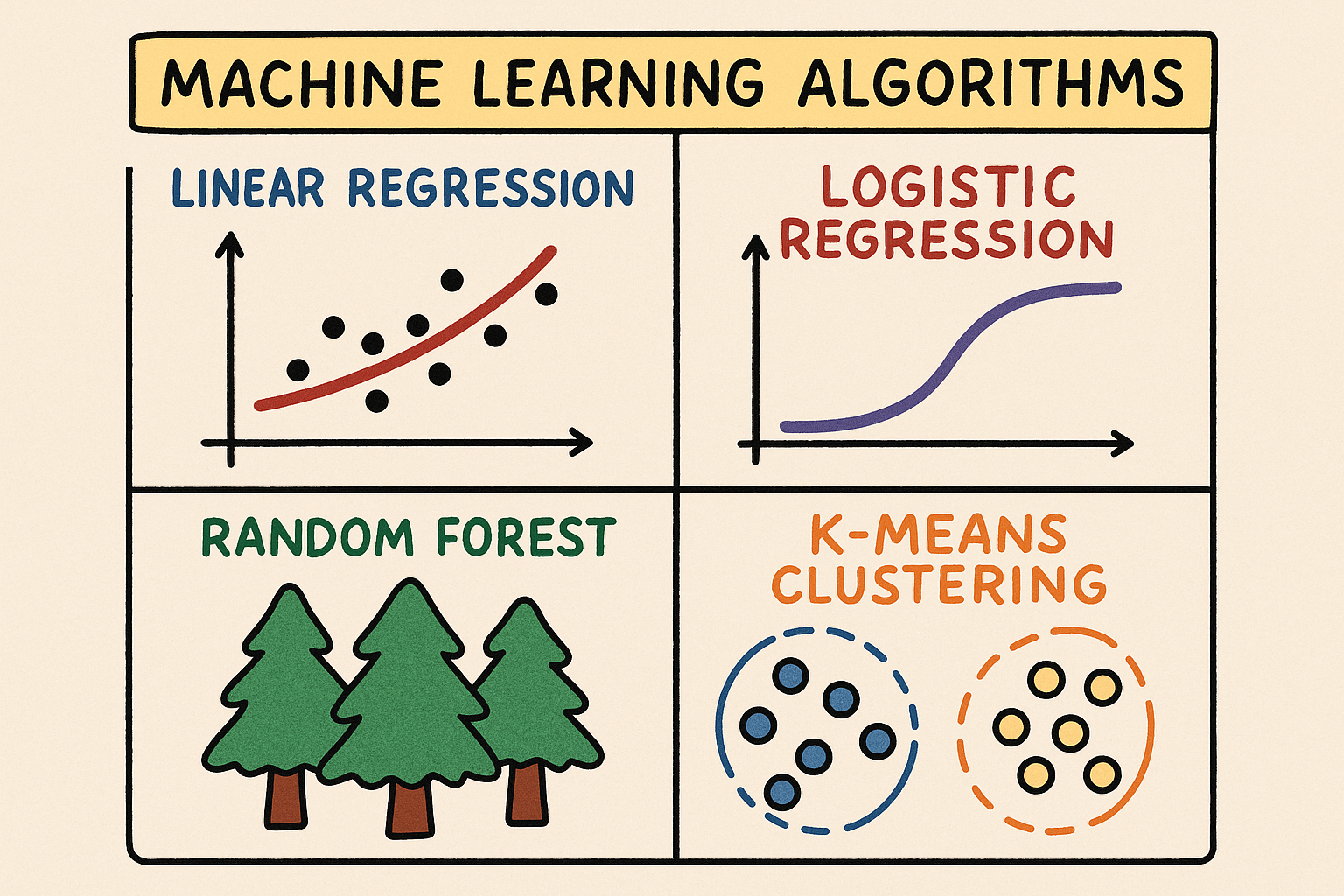
If you’ve ever nodded through a meeting where someone said “we used Random Forest for that,” this one’s for you. Let’s decode the mysterious zoo of machine learning algorithms — in plain English, no calculus required.
🧠 Step 1: The Big Picture
All of machine learning falls into three broad families:
- Supervised Learning — you have labeled data (the answers).
- Unsupervised Learning — no labels, just structure to uncover.
- Reinforcement Learning — learning by trial, reward, and error.
Supervised learning is like a student with an answer key. Unsupervised learning is the kid who makes up the rules. Reinforcement learning? That’s the one touching the stove until it learns.
🎯 Step 2: Supervised Learning — When You Have Answers
These algorithms learn from examples where you already know the outcome.
| Algorithm | Best For | Quick Analogy |
|---|---|---|
| Linear Regression | Predicting continuous values (sales, prices) | Draws the straightest line through chaos |
| Logistic Regression | Yes/No decisions (spam, pass/fail) | Adds a curve and picks a side |
| Decision Trees | Rule-based classification | 20 Questions with data |
| Random Forest | Avoiding overfitting with many trees | Democracy of decision trees |
| Gradient Boosting / XGBoost | Super-accurate tabular predictions | Trees that learn from each other’s mistakes |
| Support Vector Machines (SVM) | Cleanly separating categories | Draws the perfect wall between things |
| Neural Networks | Complex, non-linear data | The overachiever that learns everything (given enough data) |
Tip: If it’s numbers, start with regression. If it’s categories, start with trees. If nothing works — fine, use deep learning.
🔍 Step 3: Unsupervised Learning — When You Have Questions, Not Answers
When your data has no labels, these algorithms help you find patterns or simplify complexity.
| Algorithm | Best For | Quick Analogy |
|---|---|---|
| K-Means Clustering | Grouping similar items | Sorting socks by color |
| Hierarchical Clustering | Nested group discovery | Building a family tree for your data |
| Principal Component Analysis (PCA) | Dimensionality reduction | Packing your suitcase smarter |
| Autoencoders | Feature extraction and compression | Data that learns to summarize itself |
Use unsupervised learning when you’re exploring — not predicting.
🎮 Step 4: Reinforcement Learning — When the Model Learns by Doing
| Algorithm | Best For | Quick Analogy |
|---|---|---|
| Q-Learning | Sequential decisions (games, navigation) | Trial and reward learning |
| Deep Q Networks (DQN) | Large state spaces (Atari, robotics) | Playing millions of games to master one |
| Policy Gradient / PPO | Continuous control (self-driving, trading) | Learning strategies, not just actions |
Reinforcement learning is what powers robots, drones, and anything that needs to explore the unknown — safely-ish.
🧩 Step 5: Ensemble Learning — When One Model Isn’t Enough
Why pick one algorithm when you can have a team?
| Technique | Idea | Analogy |
|---|---|---|
| Bagging | Combine multiple weak learners (e.g., Random Forest) | Democracy — many vote, average wins |
| Boosting | Sequentially fix previous errors (XGBoost) | Mentorship — each learner teaches the next |
| Stacking | Combine different models for final output | Project management — everyone contributes, one person summarizes |
Ensemble methods are how you win Kaggle competitions. And arguments.
⚙️ Step 6: Choosing the Right Algorithm (A Cheat Sheet)
| Problem Type | Example | Good Starting Point |
|---|---|---|
| Predict a number | House prices | Linear Regression, XGBoost |
| Predict a category | Email spam | Random Forest, Logistic Regression |
| Group similar data | Customer segmentation | K-Means |
| Reduce features | Visualization | PCA |
| Learn actions | Game AI, trading | Reinforcement Learning |
The right model is the simplest one that works — not the flashiest one that impresses the room.
💡 The Takeaway
Machine learning isn’t about knowing every algorithm — it’s about knowing what problem you’re solving and what kind of data you have.
- Start with something simple.
- Scale to something smarter.
- Don’t fall for buzzwords that end in “Net.”
Because the best data scientists aren’t model experts — they’re pattern translators.
🧩 If you ever forget which algorithm to use, remember this rule: start dumb, measure, iterate, repeat.