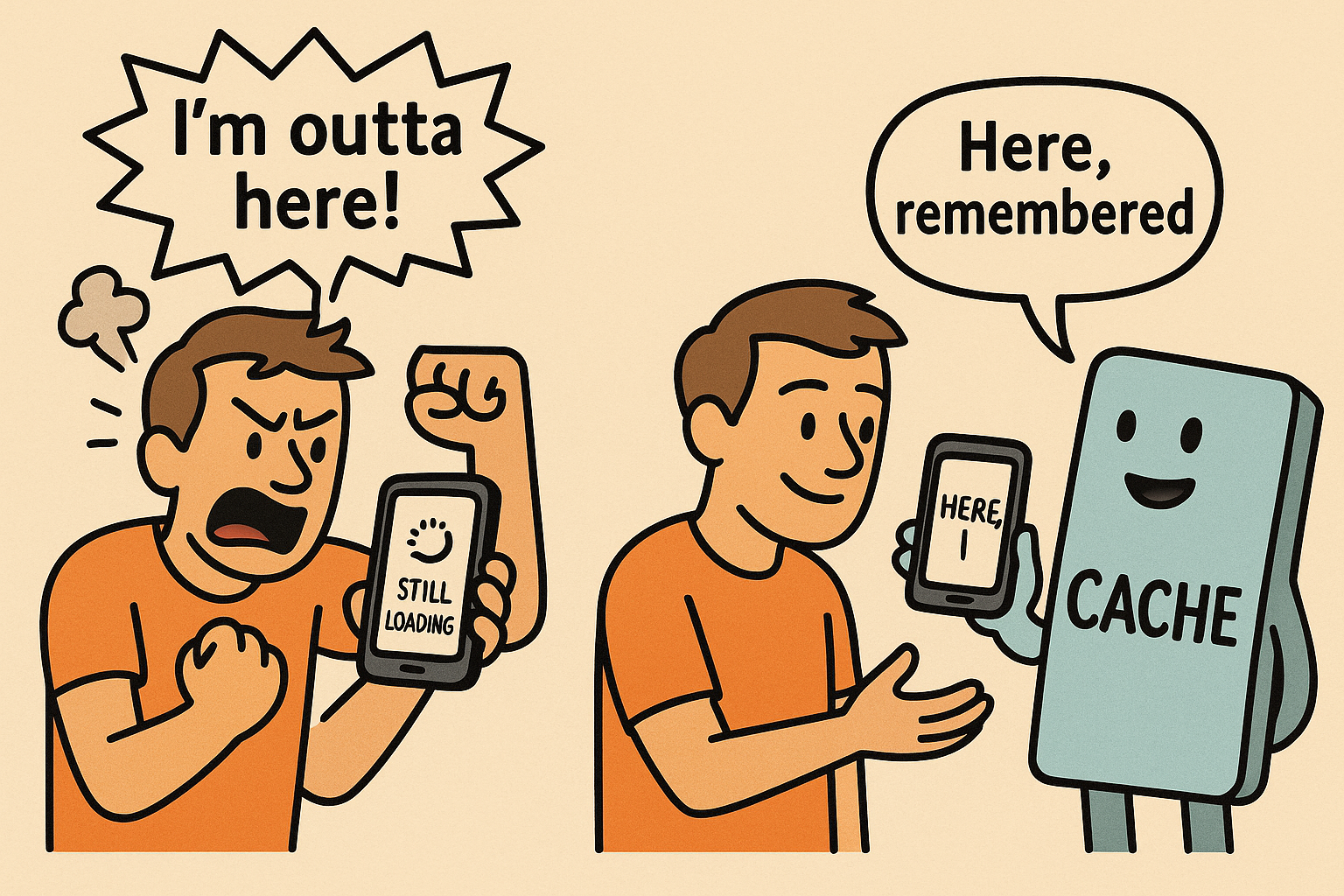
Let’s be honest: We’ve all done it.
You open an app. Tap a button. Wait. Wait more. The little spinner spins like it’s mocking you.
“Still loading… hang tight…”
💥 And boom — you're out. Close tab. Kill app. Rage-quit complete.
But what if I told you that this could have been avoided? All it needed was a good memory — and that’s what caching is.
🧠 What Is a Cache?
A cache is like short-term memory for your app.
“Hey, I’ve seen this before — let me grab it real quick instead of asking the database again.”
It stores recently used data — stuff like:
- Logged-in user info
- Product catalog
- Home screen content
- API responses
So the next time it’s needed… it doesn’t go back to the slow, cold storage room. It’s right there, already warm.
🕹️ What Happens Without It?
Let’s say you launch an app that shows trending chess puzzles.
Without a cache:
- Every user loads the app.
- Every user triggers a database query.
- Your database cries a little.
- Your users cry a little more.
Your app is now a bottleneck simulator. And your churn rate is climbing.
⚡ With Caching:
Now you preload the puzzles into a fast, in-memory store (like Redis or Memcached).
Result:
- User opens app → boom! Puzzles load instantly.
- They feel seen.
- You feel smart.
- Everyone’s happy, including your servers.
🧰 Where Do We Use Caching?
- Frontend: Save API responses in memory so you don’t refetch on every scroll.
- Backend: Cache DB queries or expensive calculations.
- CDN / Edge: Cache images, scripts, and HTML at the edge so they load faster globally.
💬 Analogy Time: Caching as a Coffee Shop
Imagine a customer orders a cappuccino. You make it fresh. Takes 3 minutes.
Then the next 10 people all order… cappuccinos.
If you cache smartly:
You make one big batch and keep some hot.
Now every new customer gets their drink instantly. No grumbling. No waiting. No Yelp reviews from angry baristas.
⚠️ But Caches Aren’t Magic
They can go stale.
- Your product price changed, but your cache still shows the old one.
- You update your homepage, but users keep seeing the cached version.
- You forget to invalidate or refresh.
A cache that never forgets… can be just as dangerous.
That’s why we use things like:
- TTL (Time to Live)
- Eviction policies (least recently used, least frequently used)
- Manual invalidation when something critical changes
🧠 Final Thought
A cache isn’t just about speed.It’s about respect.
It tells your users:
“I remembered what you asked for last time — so you don’t have to wait again.”
And in a world full of lag, being fast feels like magic.