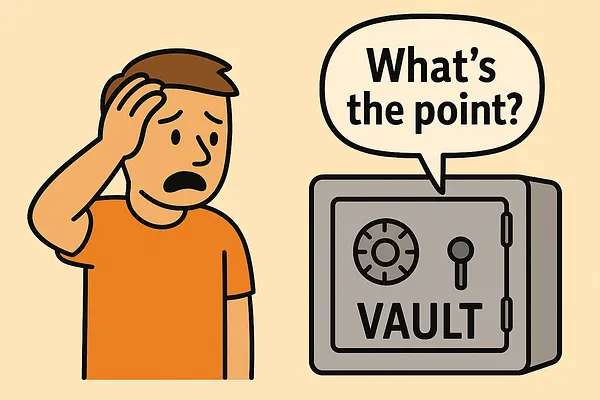
We all hear this security best practice:
“Don’t store secrets in code. Use a vault.”
Sounds smart. Until you ask the obvious question:
“But wait… where do we store the credentials to access the vault?”
Boom. Now we’re in a loop that makes even seasoned engineers raise an eyebrow.
🧭 What’s a Vault, Anyway?
A vault (like HashiCorp Vault, AWS Secrets Manager, or Azure Key Vault) stores sensitive information—think database passwords, API keys, private tokens.
It keeps secrets encrypted, access-controlled, and (ideally) auditable.
It’s like locking your valuables in a safe.
🧠 But Who Has the Safe Key?
Here’s the kicker: To open the vault, something needs to authenticate.
So where do those credentials live?
- In an environment variable?
- In a config file?
- In a hardware token?
- In cloud IAM roles?
And if someone gets those credentials... can’t they just open the vault and take everything anyway?
🤔 So... Why Not Just Store the Secret Directly?
Let’s say you’re storing a database password in Vault. But to access the Vault, you use an env var like:
VAULT_TOKEN=abcdefg
You might ask:
“Why not just store the DB password in an env var instead and skip Vault altogether?”
Great question. Here’s why vaulting is still better:
✅ 1. Separation of Secrets
Vaults allow you to centralize secret management. Instead of scattering DB passwords across microservices, you store them in one place—with proper access controls and auditing.
✅ 2. Audit Trails
Vaults log every request. If a token accesses a secret, it’s recorded. That’s hard to track with plain env vars.
✅ 3. Rotations & Policies
You can:
- Rotate secrets automatically
- Expire credentials after use
- Set fine-grained access (e.g., this app can only read db/prod/password, nothing else)
This is huge in regulated environments or large orgs.
✅ 4. Short-Lived Credentials
Many vaults don’t store fixed passwords—they generate short-lived ones on demand.
So even if your Vault token is leaked, the window for misuse might only be minutes.
🧠 It’s About Defense in Depth
The vault isn’t perfect. But it’s part of a layered security model.
Instead of saying:
“Let’s trust this one env var to protect everything,”
we say:
“Let’s use this env var to access a controlled, monitored, time-limited, auditable source of truth.”
That’s a big difference.
🚧 What Can You Do to Protect the Vault Itself?
- Use short-lived access tokens (e.g., IAM roles, service accounts)
- Don’t hardcode tokens in code or repos
- Rotate tokens regularly
- Enable audit logging on all access
- Apply least-privilege access to secrets
- If possible, use hardware-backed authentication (like TPMs or HSMs)
🧠 Final Thought
Yes—it seems ironic. You move your secrets into a vault, but now you have to guard the keys to the vault.
But you’re not just moving the secret—you’re moving the risk into a system that’s better designed to handle it.
🗝️ You're still holding a key.But now that key unlocks a smarter, safer, more trackable door.
And that’s a tradeoff worth making.