Every few months, someone says,
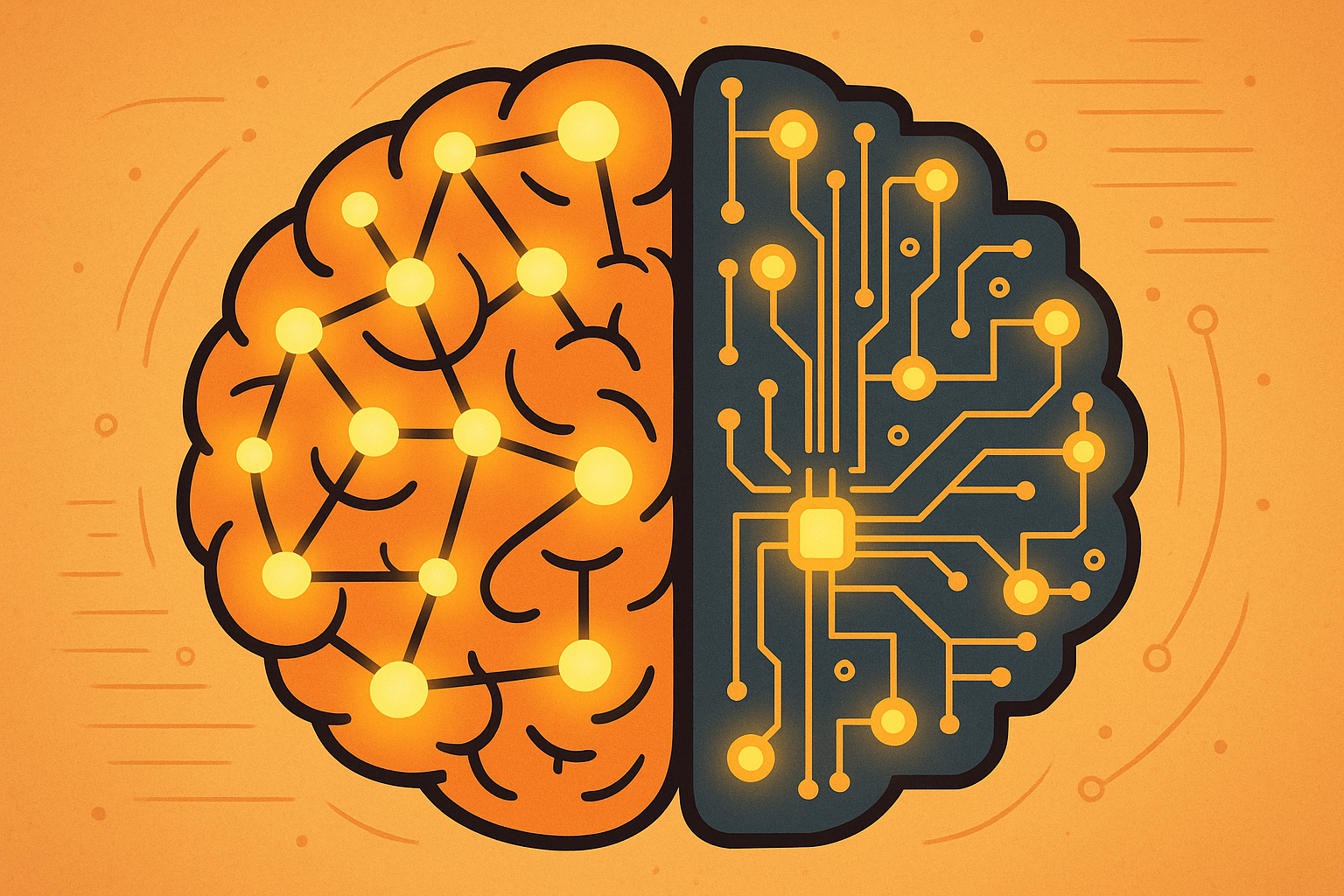
“AI models are basically like the human brain!”
And every neuroscientist sighs audibly somewhere in the world.
Because no — neural networks don’t think like us.
But they do learn in a way that’s inspired by us.
So let’s unpack it — simply, clearly, and without any terrifying equations.
🧩 Step 1: The Big Idea — Learning from Examples
A neural network doesn’t know rules.
It learns patterns from examples.
If you show it 10,000 pictures of cats and dogs,
it doesn’t memorize them.
It slowly learns what makes a cat a cat —
pointy ears, whiskers, certain shapes, certain textures.
It’s like a toddler.
Except this toddler doesn’t sleep, eat, or get distracted by snacks.
⚙️ Step 2: The Network Itself
Imagine rows of tiny lightbulbs — these are neurons (just like in the brain, but dumber).
Each lightbulb takes in some signals (numbers), processes them,
and sends a new number to the next row of bulbs.
Each connection has a weight — how much that input matters.
At first, all the bulbs flicker randomly.
That’s your “untrained” model — basically a newborn guessing wildly.
But after every guess, it’s told whether it was right or wrong.
Then it adjusts the brightness of its connections slightly.
Do this millions of times, and the bulbs start forming recognizable patterns.
That’s learning.
🔄 Step 3: The Feedback Loop
Here’s the magic — and the pain.
After each wrong answer, the model runs a process called backpropagation,
which is just a fancy way of saying:
“Figure out which bulbs messed up, and dim or brighten them accordingly.”
The model learns by being wrong — billions of times.
Which, now that I think about it, makes it even more human.
📈 Step 4: From Inputs to Insights
Once trained, the network becomes a massive web of “if this, then probably that.”
Feed it new data — say, a photo of a new animal — and it traces through all those weighted bulbs,
calculates probabilities, and spits out an answer:
“I’m 94% sure that’s a cat,
but 6% sure it’s a weird dog.”
That’s not certainty.
That’s educated guessing at scale.
🧠 Step 5: Why It Feels So Smart
Because we humans are pattern-seeking creatures too.
So when we see an AI model recognize faces, write poetry, or compose jazz,
it feels intelligent — but what it’s really doing
is surfacing patterns we didn’t realize were learnable.
It’s not understanding.
It’s mapping relationships.
And sometimes, those relationships are profound enough to look like thought.
🧩 Step 6: Why It Sometimes Fails Spectacularly
Neural networks are great at interpolation — guessing within familiar territory.
But ask them something outside their training, and they hallucinate confidently.
That’s because they don’t know what they don’t know.
They don’t know anything, really.
They just output whatever fits the pattern best.
And like a student bluffing in an exam, they’ll sound convincing right up until you check the answer key.
💡 The Takeaway
A neural network isn’t a brain.
It’s a massive calculator for probability — one that learns from feedback and imitation.
Its “intelligence” is really its persistence: it never stops adjusting, refining, guessing.
Humans forget.
Neural networks just overfit.
🧠 They don’t think — they approximate.
And somehow, that’s enough to change the world.