Let’s say you forget your email password. You type in “reset,” and the system sends you a link—not your actual password—because your password is stored as a hash, not in plain text. That’s good security.
But what if a hacker steals the hashed passwords from a database? They can’t see your password directly, but with a technique called a rainbow attack, they might still figure it out.
🔐 Hashing: The One-Way Lock
A hash function takes your password (like sunshine123) and turns it into a fixed string of characters like:
sunshine123 → 5d41402abc4b2a76b9719d911017c592
The key thing? You can go from password → hash, but not from hash → password (at least, not easily).
🌈 Enter: The Rainbow Table
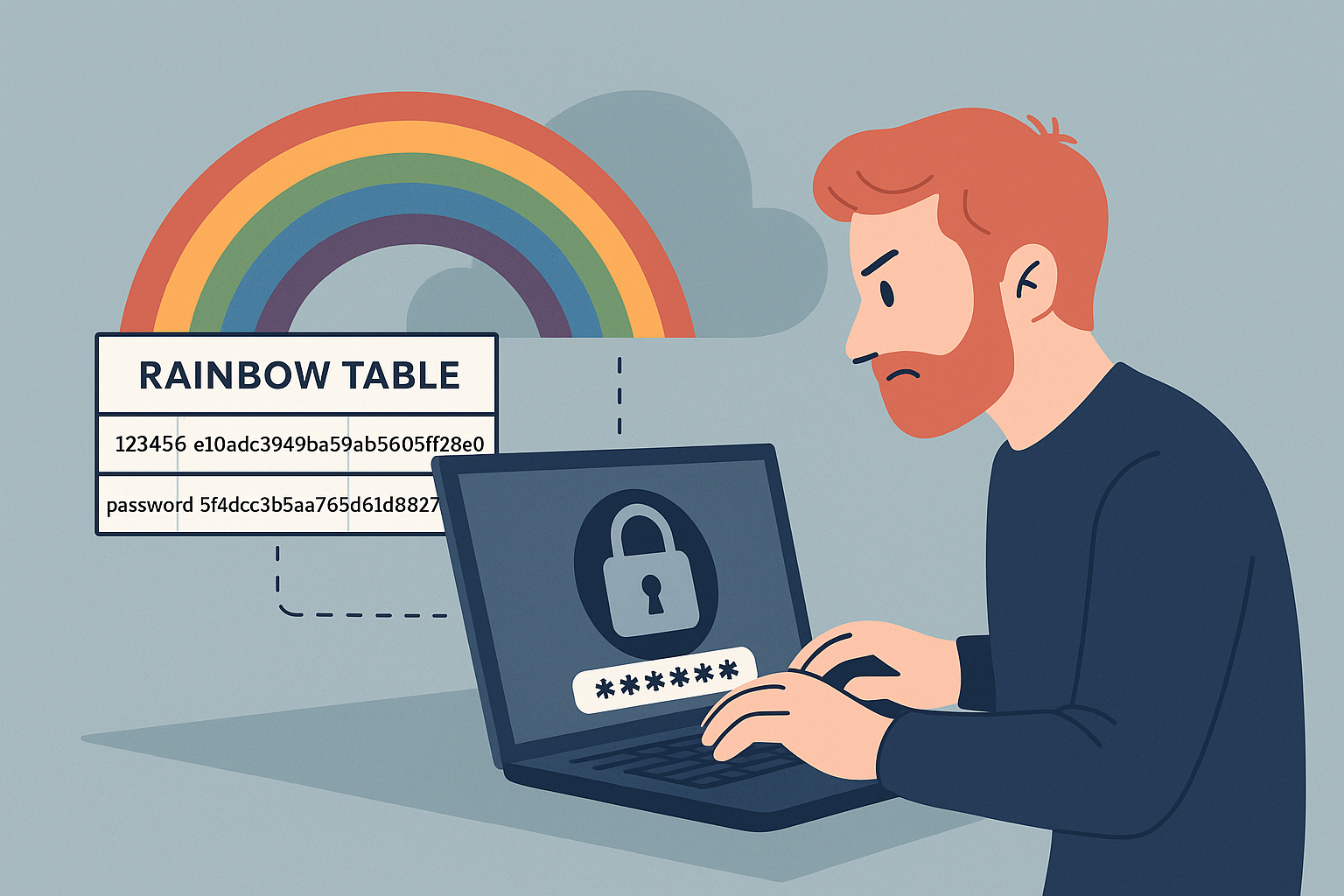
Now imagine a hacker pre-computes the hashes of millions of common passwords and stores them in a huge lookup table:
123456 → e10adc3949ba59abbe56e057f20f883e
password → 5f4dcc3b5aa765d61d8327deb882cf99
sunshine123 → 5d41402abc4b2a76b9719d911017c592
If the hacker sees a hash in your system that matches one in their rainbow table, they instantly know the password.
That’s a rainbow attack—fast, clever, and deadly if you don’t defend properly.
🧂 The Hero: Salt
A salt is a random string added to your password before hashing.
So sunshine123 + Xyz1@ → a completely different hash.
Even if two people have the same password, the hash will look different due to the unique salt.
Without salt:
- User A & User B use 123456 → same hash
With salt:
- User A: 123456 + x1 → hashA
- User B: 123456 + y7 → hashB
- ✅ No rainbow table can predict that
🧠 In Summary
- 🔒 Passwords are stored as hashes so they’re not readable.
- 🌈 Rainbow attacks use massive tables of precomputed hashes to reverse-guess passwords.
- 🧂 Salting passwords makes rainbow tables useless by making each hash unique.