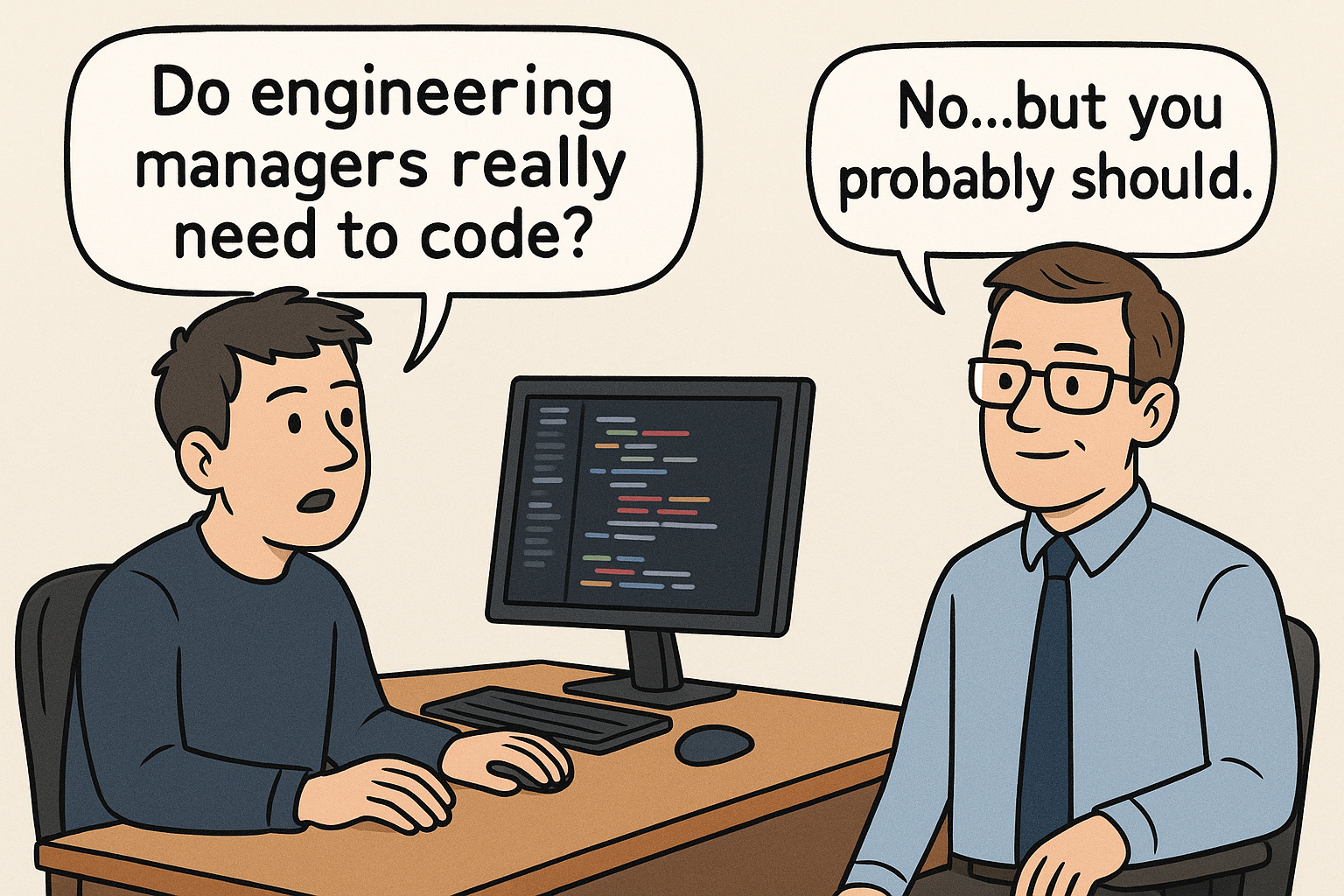
It’s a question that pops up often—especially among new managers or those eyeing leadership roles:
“Do I have to code if I’m a manager?”
Short answer? No, but you probably should.
Let’s talk about why.
🧭 Leadership Isn’t Just About Code
Being a good engineering manager is about people, priorities, and product impact. Your main job is to:
- Unblock your team
- Align with product and business goals
- Coach and grow engineers
- Make smart decisions under pressure
- Create a culture where people do their best work
You don’t need to merge pull requests daily to do these things well.
💡 But Here’s the Catch...
When you understand the tech deeply enough to talk the talk and think through architecture, you gain:
- 🧠 Credibility: Your team respects that you get it.
- 🔍 Clarity: You can assess estimates, risks, and complexity more accurately.
- 🤝 Trust: You speak the same language as your engineers and your stakeholders.
You don’t have to write code full-time. But you should understand it—enough to challenge ideas, spot red flags, and support sound decisions.
🛠️ When Managers Should Still Code
Not every org expects it. But here are cases where coding as a manager makes a lot of sense:
- 🚨 You're in a startup or small team and need to get your hands dirty.
- 🧪 You’re prototyping ideas to help product/design move faster.
- 🧠 You want to stay sharp and connected to the craft.
- 🚧 You're filling in gaps while hiring (yes, we’ve all been there).
🚫 When You Shouldn’t Code
- ❌ When it becomes a distraction from leading.
- ❌ When you start hoarding the fun tickets and leave the team with bugs.
- ❌ When it prevents someone else on the team from growing.
Leading is its own full-time job. You don’t want to be half-engineer, half-manager, fully-burnt-out.
✅ The Balanced Approach
Here’s what’s worked for me and many others:
💬 Code less, think technically more.
- Review architecture docs.
- Sit in design reviews.
- Occasionally read PRs, offer guidance.
- Write a spike or internal tool when time permits.
You’re not proving yourself through code anymore—you’re multiplying others through clarity and context.
🧠 Final Thought
Do you need to code as a manager? Not always. But it helps.
Think of it like speaking a language. You don’t have to be a poet—but if you want to lead in that country, you better be fluent enough to be understood.