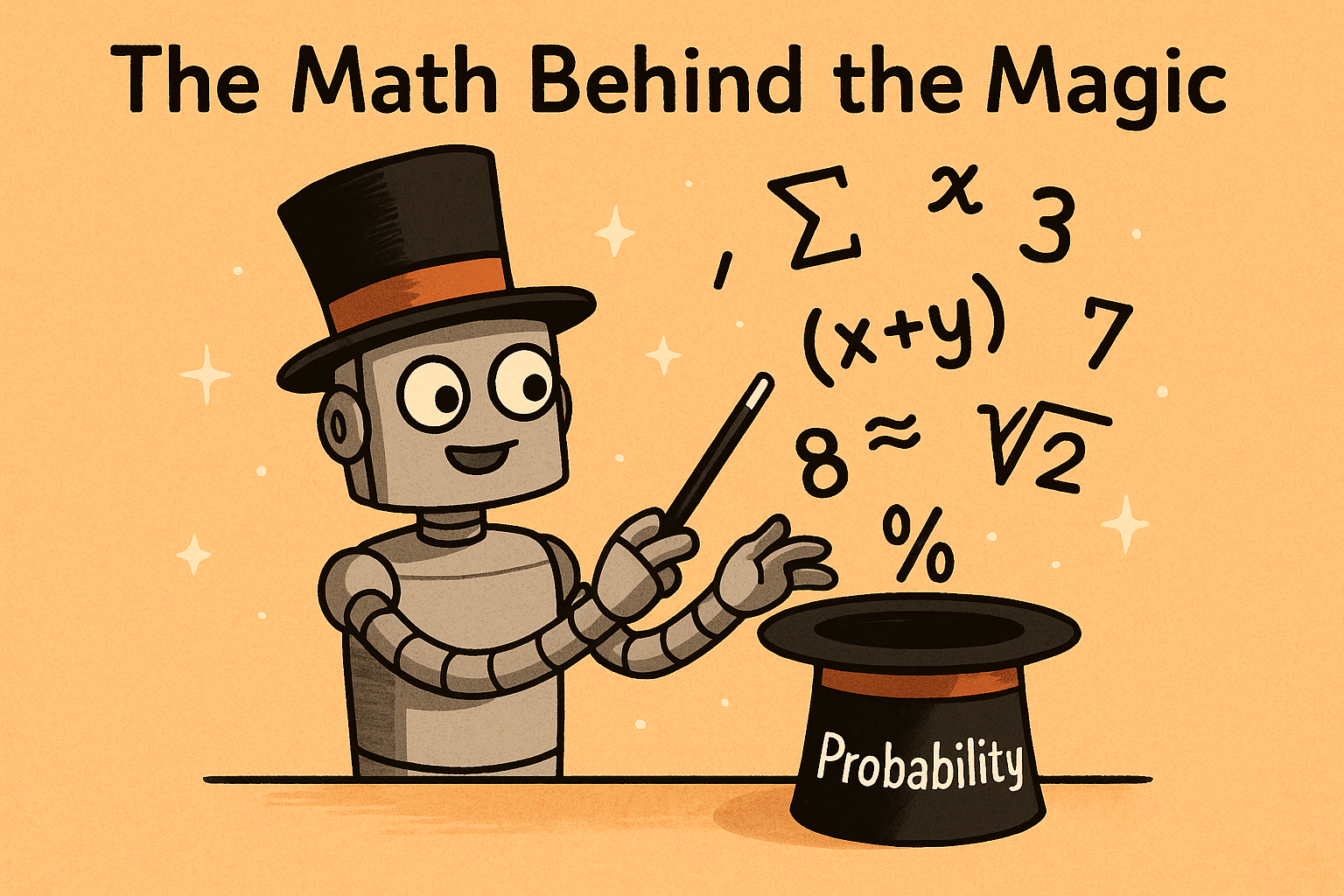
Everyone calls it Artificial Intelligence —
but deep down, most of it is just beautifully organized guessing.
Don’t get me wrong — the math is brilliant, the scale is cosmic, and the compute bill could buy you a small island.
But the core idea? It’s less “robot genius” and more “professional guesser with great memory.”
🧠 Step 1: The Great Guessing Machine
At its heart, every AI model is doing this:
“Given what I’ve seen before… what’s most likely to come next?”
That’s it.
That’s the secret.
From ChatGPT predicting your next word,
to image models predicting the next pixel,
to recommendation systems predicting your next YouTube regret.
They’re all sophisticated autocompletes — not because they know,
but because they’ve learned how to guess well.
🎲 Step 2: Probability in a Fancy Suit
Neural networks don’t store facts — they store patterns of probability.
Imagine you tell an AI,
“Roses are ___.”
It doesn’t “remember” the word red.
It just knows that in a trillion sentences, red follows roses 93% of the time,
blue follows 4%, and tired follows 0.00002% (probably from a bad poem online).
So it picks red — not because it’s right, but because it’s likely.
That’s not intelligence.
That’s probability wearing a tuxedo.
🔢 Step 3: The Math Behind the Curtain
When people say “neural networks,” it sounds mystical.
But it’s really layers upon layers of math doing one thing repeatedly:
“Take input → apply weight → multiply → add → activate → repeat.”
Each layer tweaks its internal math knobs (weights) to make better guesses next time.
And that’s how your AI slowly learns that “dog” is not “donut,”
even though the first few thousand guesses said otherwise.
Think of it as a toddler with a PhD in statistics.
🧩 Step 4: Training Is Just Correction on Loop
Training a model isn’t about inspiration — it’s about embarrassment.
You show the model millions of examples.
Each time it guesses wrong, you nudge its internal math slightly.
Do this billions of times, and it starts making fewer mistakes.
AI doesn’t “understand.”
It just stops being consistently wrong.
⚙️ Step 5: Why It Still Feels Like Magic
If it’s all just math, why does it feel magical?
Because scale turns guesswork into insight.
Give a human 10 examples, and they’ll guess poorly.
Give an AI 10 trillion, and it’ll start seeing patterns we can’t even describe.
Like:
- “This tone of writing usually means sarcasm.”
- “These pixels together usually mean cat, not chair.”
- “This sentence structure sounds emotionally supportive.”
The magic isn’t that AI guesses — it’s how well it learns what’s worth guessing.
💡 Step 6: What This Means for Us
When we call AI “intelligent,” we’re really saying it’s statistically impressive.
But there’s a big difference between guessing what’s right
and knowing why it’s right.
AI predicts — humans interpret.
AI sees patterns — humans assign purpose.
AI completes sentences — humans complete meaning.
The future isn’t about choosing between the two —
it’s about making their strengths complementary.
🎯 The Takeaway
AI isn’t a crystal ball.
It’s a mirror made of math — reflecting our data back with poetic confidence.
So the next time your chatbot sounds profound, remember:
it’s not thinking.
It’s just guessing brilliantly.
🧮 Artificial intelligence: powered by math, flavored by probability, marketed as magic.