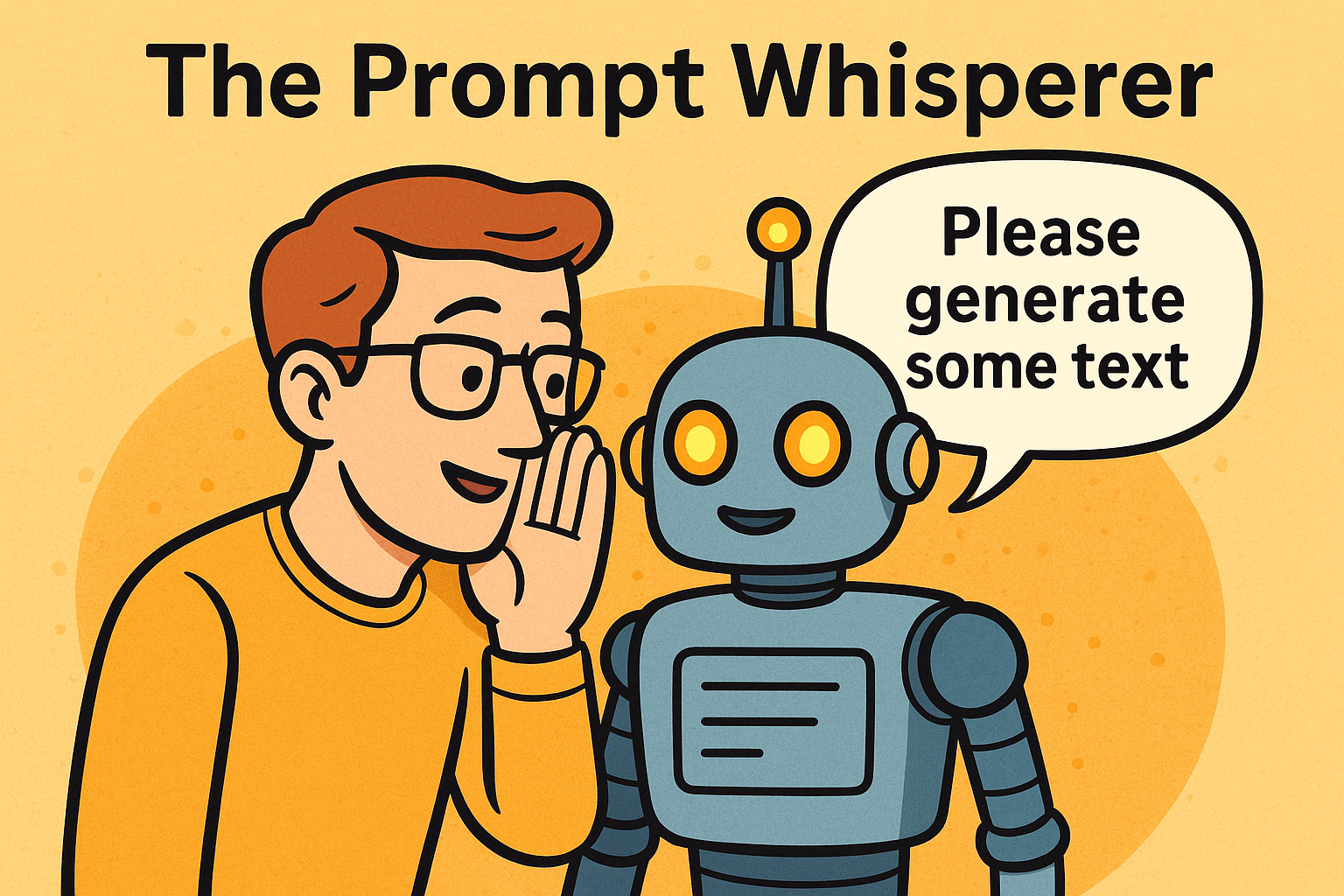
If you’ve ever used an AI model and thought,
“Wow, it really understood me,”
and then, five minutes later, thought,
“This thing is completely useless,”
congratulations — you’ve met your first moody genius.
Welcome to the world of prompt engineering,
where the difference between brilliance and nonsense
is just one comma, a polite tone, and maybe a little flattery.
🧠 Step 1: It’s Not Coding — It’s Communication
We like to think talking to AI is technical.
But really, it’s emotional.
You don’t program large language models — you negotiate with them.
A prompt isn’t an instruction; it’s a conversation opener.
Say:
“Write a summary.”
You’ll get an essay.
Say:
“Explain this to me like I’m five.”
You’ll get philosophy in kindergarten language.
Say:
“You are an expert editor with 20 years of experience. Tighten this paragraph.”
You’ll get an email worthy of The Economist.
LLMs respond to context and character, not just commands.
It’s less “syntax,” more “psychology.”
🎭 Step 2: Every Model Has a Personality
They say models don’t have feelings.
And yet, they clearly do.
They get passive-aggressive if you’re vague.
They ramble if you don’t set boundaries.
They go silent if you confuse them.
They hallucinate when they panic.
They’re basically introverted coworkers with Wi-Fi access.
The trick isn’t to control them — it’s to coach them.
A good prompt whisperer doesn’t yell “Do this!”
They say, “Let’s think this through together.”
And somehow, it works.
🧩 Step 3: Why Context Is Everything
Language models are like improv actors.
They don’t know the script — they just play along with whatever you set up.
So if you say,
“You’re a cybersecurity expert giving a TED Talk,”
they’ll suddenly wear a metaphorical blazer and speak in confident bullet points.
If you say,
“You’re a tired engineer explaining this to your dog,”
they’ll drop the jargon and add personality.
Prompting is basically role-playing for algorithms.
And just like people, AIs do better when they know who they’re supposed to be.
⚙️ Step 4: The Rules of the Whisperer
Here’s what great prompters know instinctively:
-
Give it a role.
Define who it is before what it does. -
Set tone and format.
Say “in bullet points” or “as a casual blog post” — never assume. -
Be polite.
Yes, it matters. Models trained on human patterns respond better to cooperative language.
“Please” and “thank you” might just improve accuracy (and your karma). -
Show examples.
Humans learn by demonstration.
Turns out, so do machines.
🪞 Step 5: The Mirror Effect
Here’s the twist — prompting isn’t really about the model.
It’s about you.
The clearer your thinking, the better your output.
The more specific your goal, the smarter the response.
Prompt engineering is really thought engineering.
AI doesn’t make you think less.
It makes your thinking visible.
💬 Step 6: The Human Secret
Every great prompt whisperer eventually learns this truth:
You’re not teaching AI to understand you.
You’re learning to understand yourself — in structured sentences.
The act of writing a good prompt is the act of clarifying thought.
And that’s why it feels magical — because clarity is magic.
💡 The Takeaway
The best AI conversations don’t feel mechanical.
They feel like collaboration.
Because under all the math and data, what these models really mirror
is the intent, tone, and curiosity of the person talking to them.
So next time you talk to an AI, remember:
- Be clear.
- Be kind.
- And if it still hallucinates — just nod, like you’re dealing with a very confident intern.
🧩 Prompt wisely. You’re not just programming intelligence — you’re shaping reflection.