Everyone says “we’re moving to the cloud.”
But ask three teams what that means, and you’ll get five answers.
For some, it’s AWS.
For others, it’s Kubernetes.
And for a few brave souls in enterprises — it’s PCF, running on-prem behind a firewall named after someone’s retired boss.
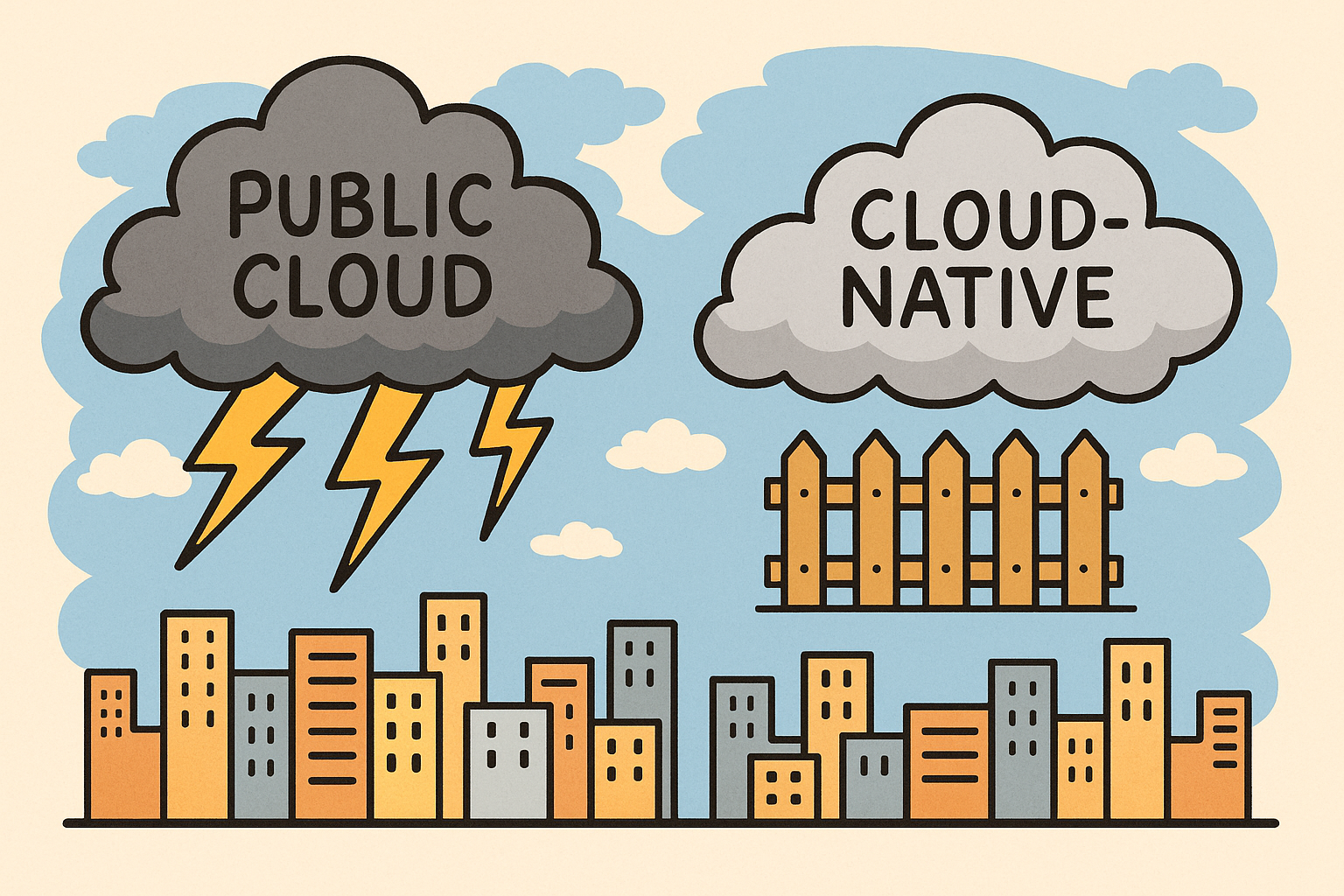
Welcome to the cloud world — same sky, wildly different weather.
☀️ Public Cloud: Freedom with Fine Print
Public clouds are like all-you-can-eat buffets.
You walk in for a small EC2 instance, and by dessert, you’ve provisioned 12 VPCs, a Kafka cluster, and two existential crises about billing.
The good part:
- You can deploy anything, anywhere, anytime.
- You can scale from one user to a billion (assuming your credit card scales too).
- You get access to shiny services like AI APIs, managed DBs, and global load balancers that make you feel like NASA.
The fine print:
- Every service has nine pricing tiers and one free tier that mysteriously expires at 2 a.m.
- IAM policies are written in hieroglyphs.
- One misconfigured S3 bucket can end your compliance career.
Public clouds give you infinite freedom — but also infinite ways to regret it.
🌧️ Cloud-Native Platforms: Freedom Inside Fences
Then there’s the cloud-native approach — platforms like PCF, OpenShift, or internal Kubernetes clusters that promise the same magic, but with more rules.
Think of it as the “community swimming pool” of cloud computing.
You can’t build a water slide, but at least there’s a lifeguard.
The good part:
- Opinionated pipelines.
- Standardized deployments.
- Security, compliance, and governance already baked in.
You trade some flexibility for predictability — and in enterprises, predictability is gold.
The catch:
You can’t spin up random experiments at midnight, and your YAML still needs to pass 47 internal validations before deploy.
Everything works — as long as you color inside the lines.
⚡ The Real Trade-off: Velocity vs. Visibility
Public cloud is for teams that move fast and (hopefully) don’t break prod.
Cloud-native is for teams that prefer guardrails, governance, and sleep.
One optimizes for speed, the other for sanity.
Public cloud gives you tools.
Cloud-native gives you templates.
The trick is knowing which one your team actually needs.
A startup with three developers and a dream doesn’t need policy-driven pipelines.
But an enterprise processing billions of transactions definitely does.
🌈 Same Sky, Different Weather
Both approaches work.
Both can fail spectacularly.
The difference isn’t technical — it’s cultural.
Public cloud fits organizations built on trust and autonomy.
Cloud-native fits organizations still learning to delegate without panic.
One says, “Go build whatever you want.”
The other says, “Go build whatever you want… after security signs off.”
Neither is wrong — they’re just different climates under the same sky.
☕ The Takeaway
When someone proudly says, “We’re cloud-native now,” ask them what that means.
Because sometimes it means AWS Lambda.
Sometimes it means PCF with Jenkins.
And sometimes it means a shared Excel sheet labeled ‘deployment tracker.’
In the end, cloud-native isn’t about where your code runs — it’s about how your team thinks.
☁️ The best cloud isn’t public or private — it’s the one that doesn’t rain on your Friday deploy.