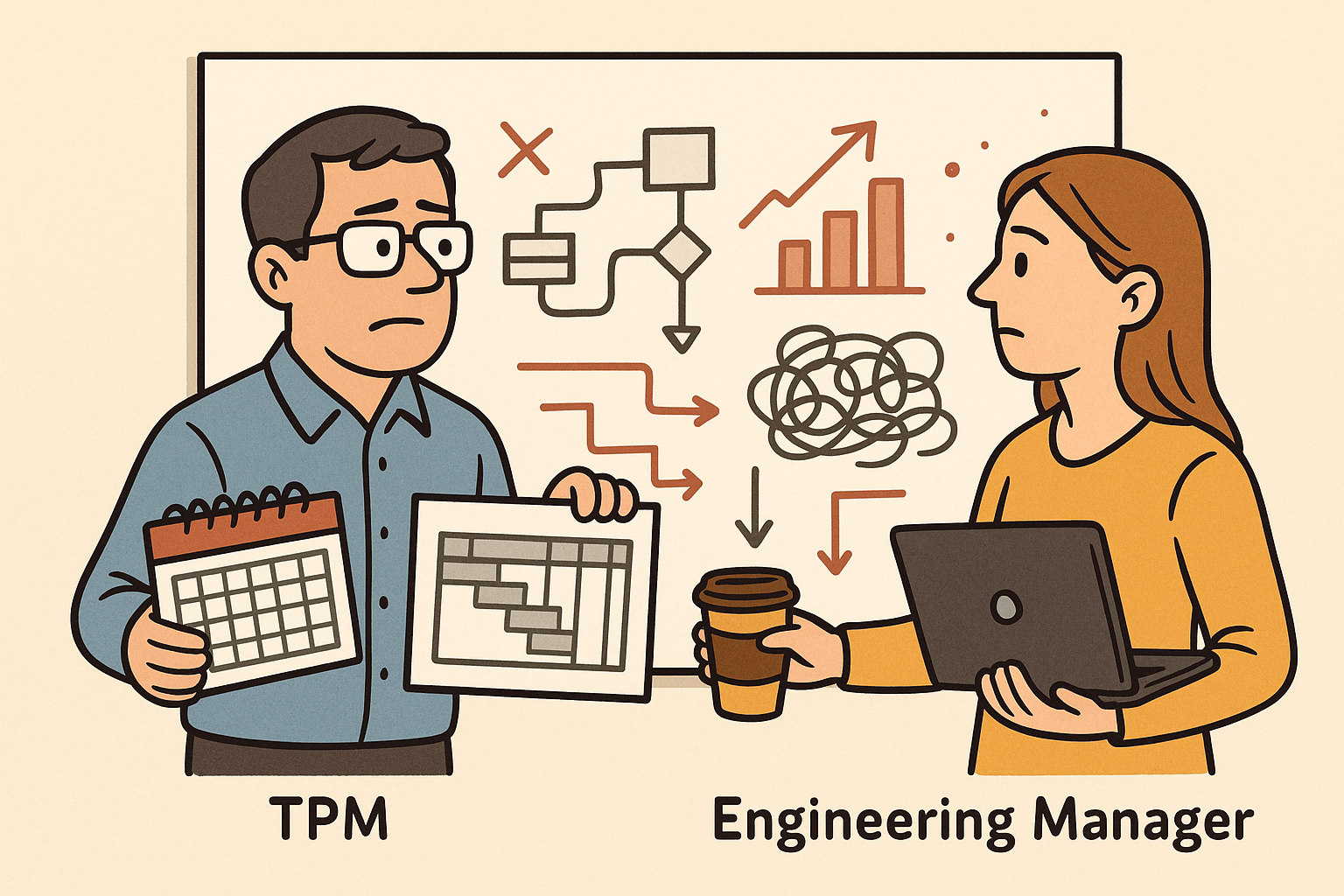
If you’ve ever worked in tech long enough, you’ve seen this scene:
Two people in a meeting both nodding at the same sentence —
but for completely different reasons.
One is a Technical Program Manager (TPM).
The other, an Engineering Manager (EM).
Both are aligned. Both are polite. Both will later tell their teams totally opposite things.
Let’s talk about why.
🧭 The TPM’s Universe: Deadlines, Dependencies, Diplomacy
A good TPM is part air traffic controller, part therapist, part diplomat.
They don’t write code — they untangle it.
Their natural habitat:
- Jira boards with 187 open tickets.
- Docs titled “Master Plan_v7_FINAL2.”
- Slack threads that begin with “Can we sync quickly?”
They live for alignment — and dread the words “we’ll need one more sprint.”
A TPM’s favorite metric: Predictability.
If engineering is an orchestra, the TPM is the conductor making sure everyone plays in the same key — even if half the instruments are on different time zones.
💻 The Engineering Manager’s World: People, Code, and Sanity
The Engineering Manager, meanwhile, is trying to keep the orchestra alive.
They worry about:
- Burnout.
- Architecture debt.
- That one developer who just refactored a module “for fun” mid-sprint.
Their day is a balance of one-on-ones, code reviews, hiring plans, and the occasional existential crisis about whether they’re still technical enough.
An EM’s favorite metric: Sustainability.
They want quality, growth, and calm — preferably all before 5 p.m. and before the next incident page.
☕ Same Meeting, Different Focus
In the same meeting, this is what happens:
| Topic | TPM Thinking | EM Thinking |
|---|---|---|
| “We’re behind schedule” | How do I adjust scope without alarming leadership? | Who overloaded my team again? |
| “We need a design change” | That’s a risk to our milestone. | Finally, someone noticed the design flaw I’ve been hinting at for weeks. |
| “We’ll need a spike.” | Oh no, timeline slip. | Oh good, someone’s actually exploring before coding. |
| “We’re 90% done.” | Great! Let’s update the tracker. | 90% done means we just started testing. Hold my coffee. |
They’re hearing the same words — but decoding different universes.
🧩 The Overlap That Confuses Everyone
Both roles care about:
- Delivery.
- Clarity.
- Quality.
- Communication.
But the difference is in what they optimize:
- TPM: Outcome predictability.
- EM: Outcome health.
TPMs ensure things ship.
EMs ensure people survive the shipping.
A project can be on time but unsustainable — or healthy but late.
The art of leadership is finding the balance where both roles can win.
🚀 When Roles Blur (and That’s Okay)
In smaller teams, one person often wears both hats.
That’s how many EMs accidentally discover their inner TPM — creating roadmaps, aligning cross-teams, soothing product managers, and gently reminding execs that “adding more engineers” doesn’t halve delivery time.
When done right, it’s powerful.
When done wrong, it’s burnout disguised as efficiency.
If you’re filling both roles temporarily, remember:
A good TPM protects the schedule. A good EM protects the people.
You can do both — just not at the same time.
🧠 The Leadership Lesson
The best organizations don’t force TPMs and EMs to compete.
They make them complement each other.
Because when a TPM’s structure meets an EM’s empathy,
you get something rare:
a team that’s both predictable and proud.
💡 Projects succeed when programs align with people — not the other way around.