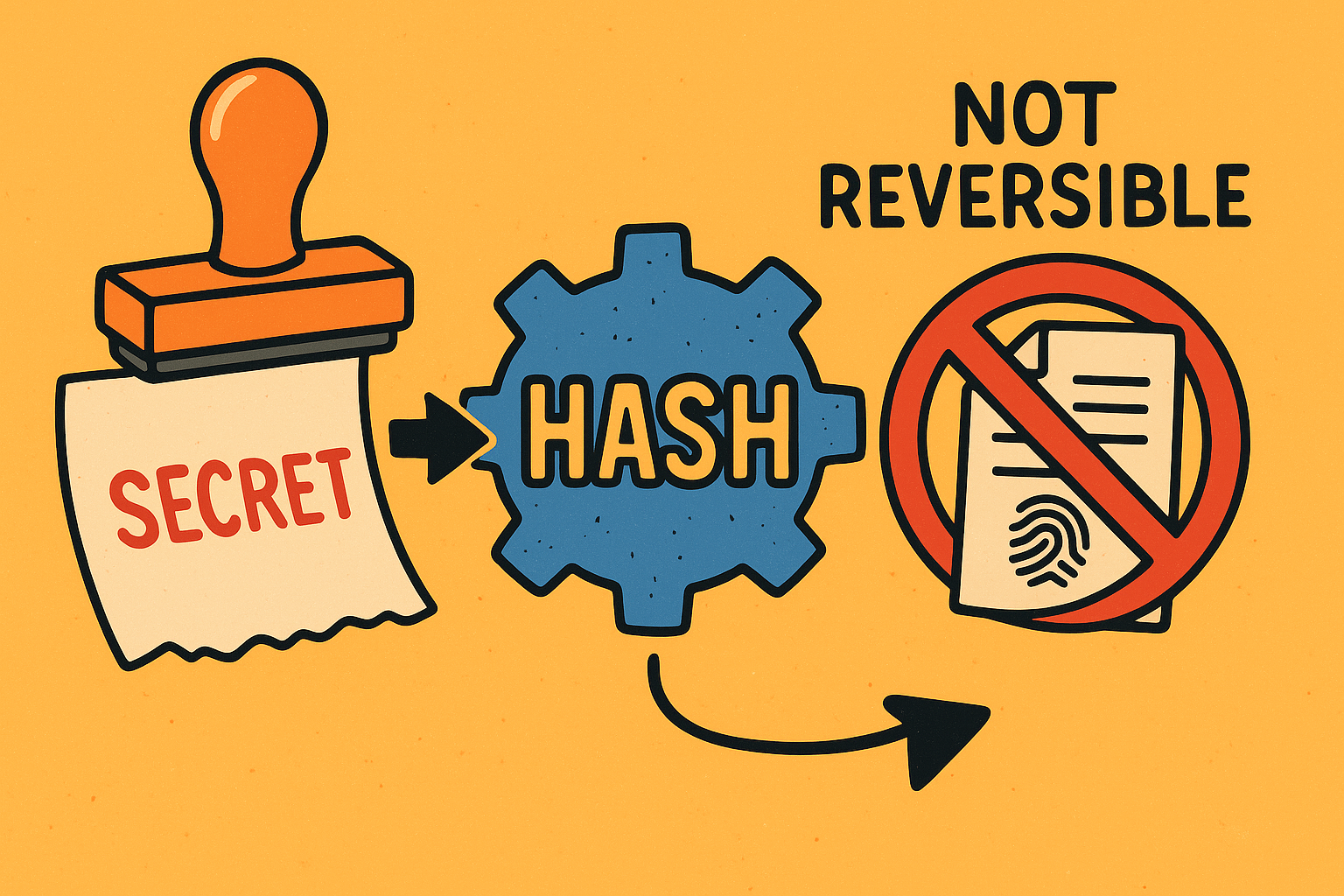
Let’s talk about hashing — one of the most misunderstood tools in a developer’s security toolbox.
Too often, I see teams reach for a hash function when what they really need is encryption. Or worse — they treat hashing like a silver bullet that magically “secures” data. Spoiler: it doesn’t work that way.
So here’s a plain-English breakdown of what hashing actually does, when to use it, and how to avoid the common pitfalls.
🔍 What Is Hashing?
Hashing is a one-way function that takes some input (like a password or email address) and produces a fixed-length output called a hash. The same input will always produce the same output — but it’s designed to be impossible to reverse.
Think of it like a digital fingerprint:
- It’s unique to the input
- You can compare fingerprints to see if two inputs match
- But you can’t recreate the original from the fingerprint
⚠️ Hashing Is Not Encryption
This is the mistake most teams make:
They treat hashing like encryption — but it’s not reversible.
If you hash a credit card number, you’ll never get the original back. That’s great for verifying passwords, but terrible if you need to recover or re-use the data — like sending it to a payment processor.
✅ When You Should Use Hashing
Hashing shines in situations where you only care about matching values — not retrieving them.
Good use cases:
- Password storage (with a salt and a slow hash function like bcrypt or Argon2)
- Deduplicating emails or PANs in logs without storing the raw values
- Anonymized analytics or fraud detection
In all of these, you don’t care about getting the original data back — just whether the same input has appeared before.
❌ When You Shouldn’t Use Hashing
If you need to retrieve or transmit the original data, hashing is the wrong tool. That includes:
- Storing credit card numbers (PANs)
- Saving Social Security Numbers or national IDs
- Encrypting sensitive profile data (names, addresses, etc.)
- Anything you plan to decrypt or view again
For those, use encryption — ideally with AES-256 and proper key management.
🔐 Hashing + Salting = Good Practice
When storing passwords:
- Always use a salt (a unique, random string) for each user
- Use a slow hashing function (bcrypt, scrypt, Argon2)
Don’t use:
- MD5 (broken)
- SHA-1 (broken)
- Fast hash functions like SHA-256 for passwords (too fast = easier to brute force)
Real Talk
Hashing isn’t a magic shield. It won’t make sensitive data safe if you're using it in the wrong place.
If you're storing anything sensitive and think "I'll just hash it," ask yourself:
**Do I need to get this data back later?**If the answer is yes — use encryption instead.
Hashing is amazing when used correctly — but when misused, it creates a false sense of security. That’s worse than having no security at all.
Closing Thought
Hashing isn’t broken — misuse is.
Understand the tool, apply it with purpose, and you’ll not only build more secure systems — you'll avoid cleaning up messes no one else wants to touch.