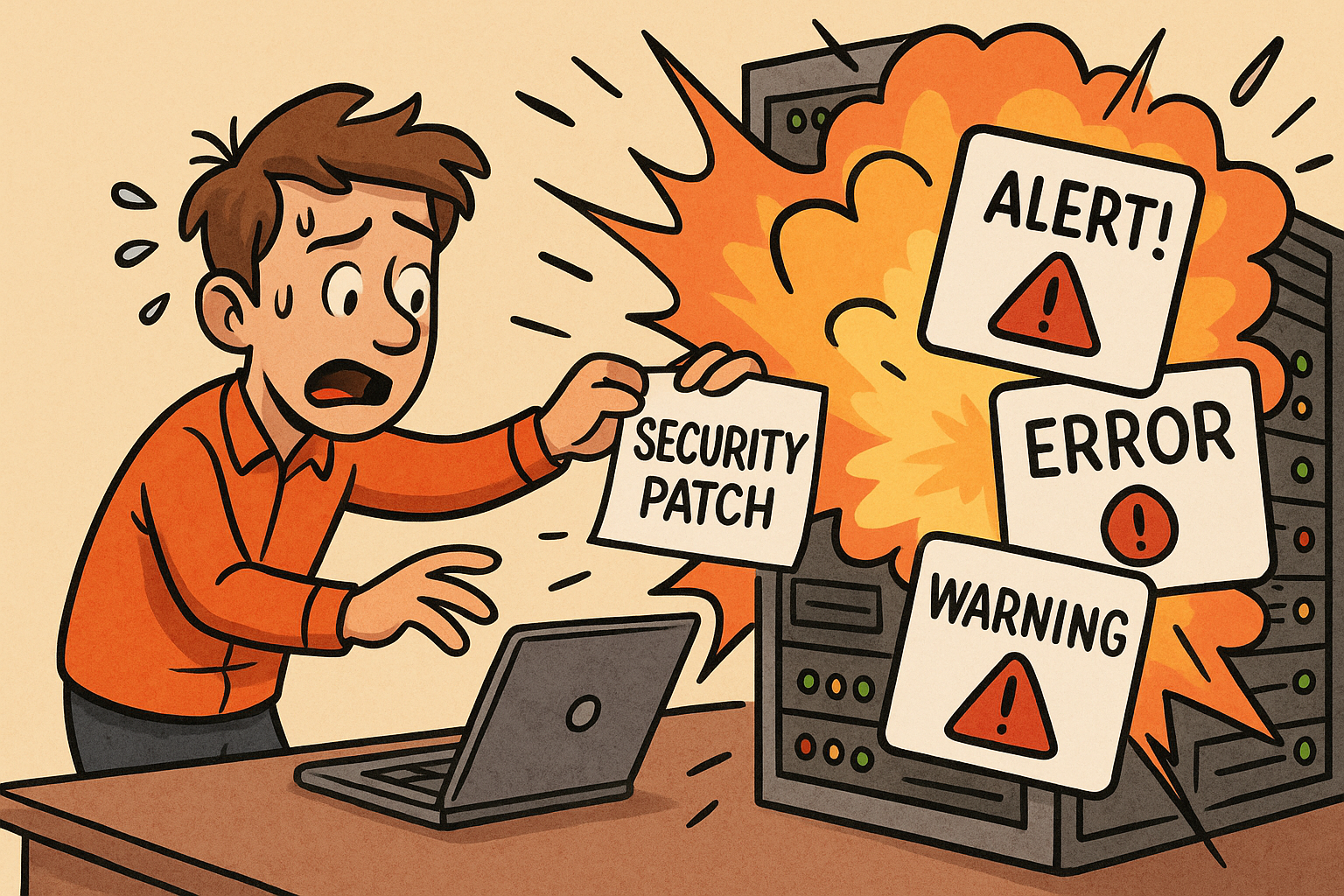
Every great disaster starts with the same words:
“It’s just a quick fix.”
Somewhere, an engineer merges a two-line change, deploys it on a Friday, and waits for applause.
Instead, the internet burns. Dashboards cry. Slack channels explode into 247-message threads titled “URGENT: WHO MERGED THIS?”
The irony?
It wasn’t even a bug fix. It was a security patch — the noblest of intentions gone rogue.
🔐 Act I: The Patch
The story begins like all security stories do — with panic.
A new vulnerability is found in a popular library.
CVE-something-something-critical-remote-code-execution.
Your security lead posts the link with the urgency of a fire alarm.
“We need to patch this immediately.”
“Production?”
“Everywhere.”
Someone opens a pull request.
It looks harmless.
Just a version bump and a couple of dependency updates.
They test it locally. It works.
They test it in staging. It works.
They deploy to prod.
And that’s when the universe decides to get involved.
💣 Act II: The Ripple Effect
Within minutes, monitoring lights up like a Christmas tree.
Services start throwing 500s.
Third-party integrations fail.
The mobile app shows a blank screen.
Someone yells, “Roll back!”
Another replies, “Can’t — the rollback script depends on the same library we just patched.”
In the chaos, someone opens a ticket:
“Critical: Login flow broken after patch.”
Then another:
“Payments API timing out.”
Then a third:
“Our Slack bot started sending poetry instead of alerts.”
It’s not just a broken build anymore — it’s a full-blown ecosystem event.
🧩 Act III: The Blame Game
By this point, the incident channel has 86 people.
No one’s sure who’s leading it, but everyone’s typing.
Security says, “We told you to patch.”
Engineering says, “You said immediately.”
Ops says, “We said not on Friday.”
Meanwhile, product management wants to know:
“Can we hotfix the hotfix?”
Leadership calls an emergency meeting titled “Learning From This Incident (but really finding who approved it).”
Slides are made. Postmortems are drafted. A new process is born.
And just like that, your two-line change created six new policies and one new steering committee.
🧠 The Real Lesson
This isn’t just about code.
It’s about how systems respond to pressure.
When we treat every security alert as a fire, we forget that firefighting without structure burns the team instead.
When we rush to “just fix it,” we skip the only thing that makes engineering stable: context.
Because patching software isn’t hard.
Patching systems of people is.
🧭 The DevSecOps Parable
Security patches are like corporate decisions:
- Well-intended but often untested.
- Urgent but disconnected from downstream impact.
- And always harder to roll back than you think.
True DevSecOps isn’t about faster fixes — it’s about safer thinking.
It means:
- Integrating security earlier.
- Automating tests before panic sets in.
- And reminding teams that immediate doesn’t mean reckless.
🌍 The Moral
The next time someone says,
“Let’s just apply the patch — what could go wrong?”
Pause.
Take a breath.
Run a test.
Ping ops.
Ping QA.
Ping your future self, who will thank you for not breaking production during dinner.
Because in engineering — and in life —
the smallest patches often reveal the biggest cracks.
💡 Fix fast, but think slow. That’s how you secure more than your code.