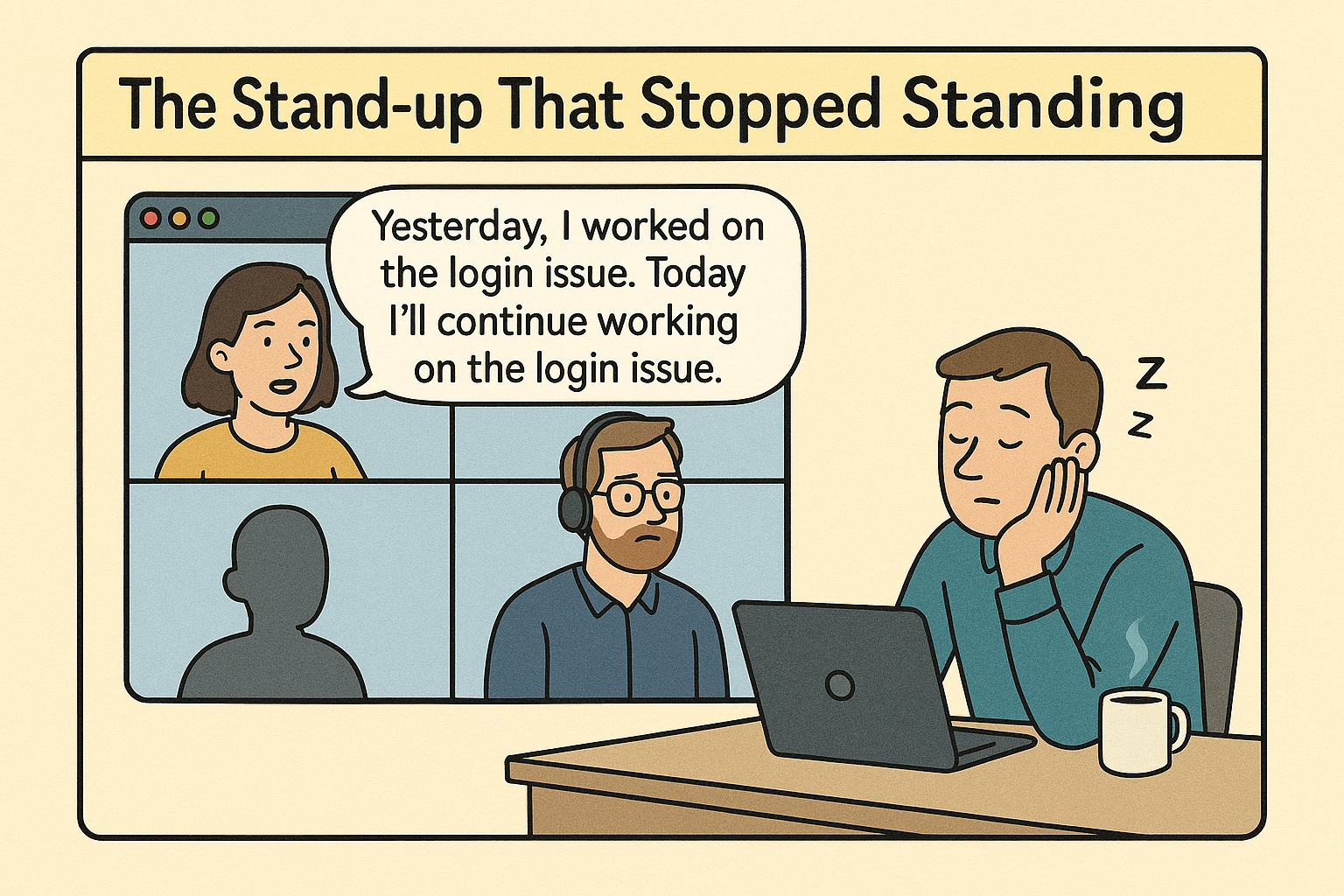
There was a time when stand-ups actually stood up for something.
A brisk 15 minutes. Everyone literally standing. Energy. Focus. A sense of purpose.
Fast-forward to today — half the team’s cameras are off, someone’s still connecting audio, and another brave soul is reciting:
“Yesterday, I worked on the login issue. Today, I’ll continue working on the login issue.”
The only thing standing now is the silence that follows.
🧍♂️ How Did We Get Here?
Somewhere between “Agile transformation” and “corporate calendar overload,” the stand-up mutated.
What was meant to be a quick sync to unblock work became a daily broadcast of who’s doing what — as if Jira and Slack went on strike.
Managers started using it as a mini status meeting.
Developers started reading from Jira like bedtime stories.
And Scrum Masters started timing people like chess arbiters.
It’s not malice. It’s momentum — meetings have a strange evolutionary trait: they grow until they fill all available patience.
🧩 The Original Intent (That Everyone Forgot)
The original Agile Manifesto didn’t say:
“Individuals and interactions over comprehensive documentation... but let’s still do a daily monologue at 9:30 AM.”
The point of a stand-up was never to report progress; it was to surface friction.
It was meant for conversations like:
- “I’m blocked on the API deployment.”
- “I need help testing this scenario.”
- “Can we decide on that endpoint contract before I build the wrong thing?”
In other words — talk about the obstacles, not the odometer.
😅 Symptoms That Your Stand-up Has Stopped Standing
If you recognize two or more of these, congratulations — you’re sitting in a “stand-down”:
- People say “Nothing much yesterday, same today.”
- You need a Scrum Bot to remember who spoke last.
- Cameras are off, mics are half-muted, spirits fully muted.
- The only unblocked thing is the calendar invite.
- Someone just said, “We’ll take that offline,” and no one ever did.
🧠 How to Bring It Back to Life
Here’s how to revive your stand-up before HR revokes your “Agile” card:
1. Change the questions.
Instead of “What did you do yesterday?”, ask:
- “What’s the biggest blocker today?”
- “What can help you go faster?”
- “Who can you pair with to solve it?”
2. Rotate the facilitator.
Let someone new lead every day. It breaks monotony and builds empathy for the Scrum Master’s daily courage.
3. Go async — but smartly.
If your team is global, use an async bot for updates — but keep one live sync per week just for discussion. Don’t let “async” become “absent.”
4. Celebrate micro-wins.
“Feature deployed to prod without rollback” deserves a cheer.
A quick 20-second celebration lifts morale more than 200 words of Jira reading.
5. End with a spark.
Ask: “What’s one thing we’re proud of this week?”
Because teams that smile together deliver together.
🚀 The Stand-up’s True Purpose
A great stand-up doesn’t track progress — it amplifies connection.
It reminds everyone that we’re building together, not just reporting individually.
So next time you join one, don’t read a script.
Stand up — and speak to unblock, not to update.
Because if your “stand-up” doesn’t make you feel slightly more awake than before it started —
it’s probably time for a sit-down talk about your stand-up.