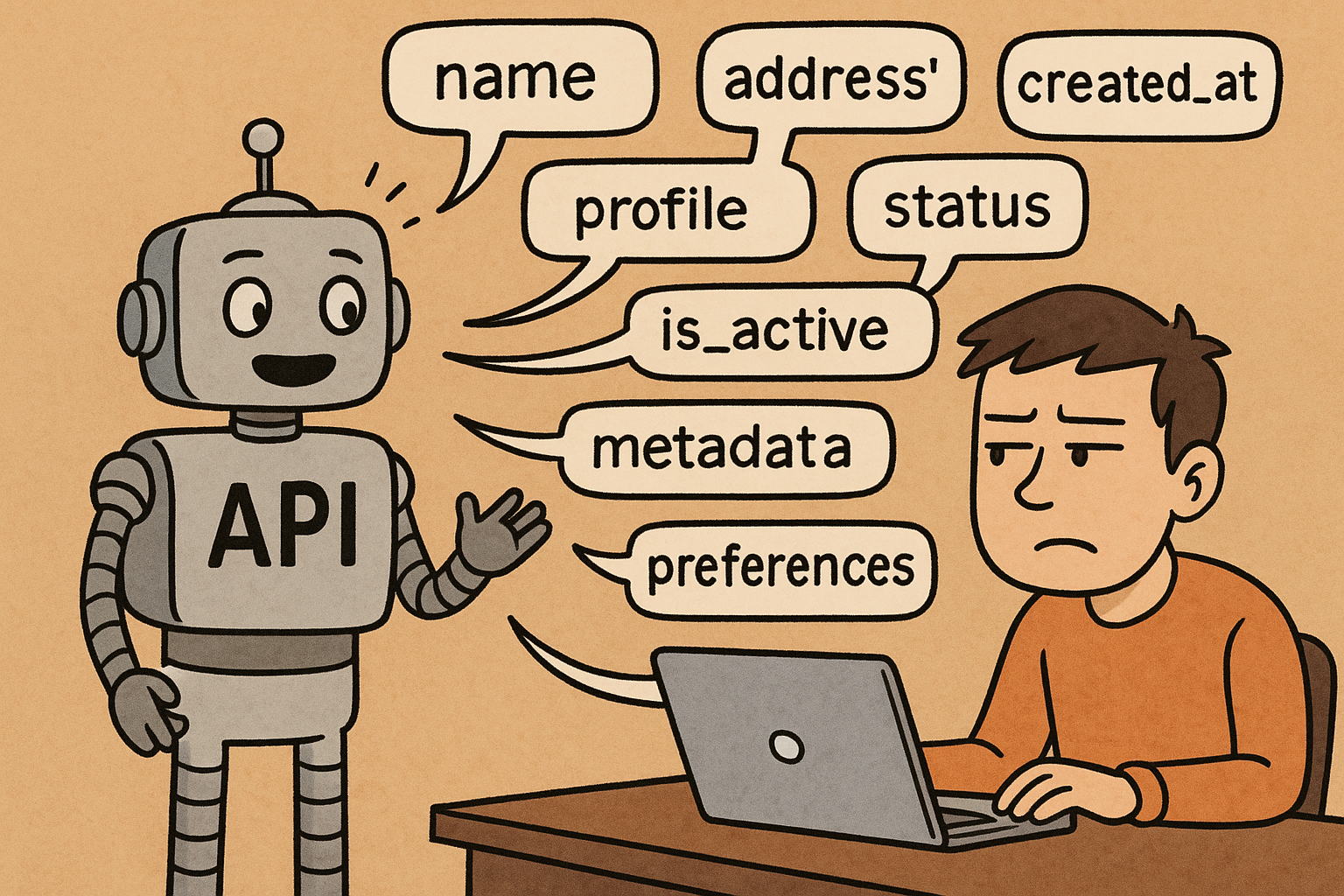
Every company has that one API.
You know the one.
The “tell me everything about everything” endpoint.
The one that proudly returns a payload longer than your team’s sprint retrospective notes.
It’s the API that doesn’t just answer questions — it writes essays.
It’s self-aware, verbose, and convinced that every downstream consumer wants to know about its childhood variables.
🗣 The API That Wanted to Be Heard
It started with good intentions.
A product manager once said:
“Let’s make this flexible, so clients can get everything they need.”
A noble thought.
Then someone added optional fields. Then nested optional fields. Then filters for the optional nested fields.
By version 3, it had become an autobiography in JSON.
Developers no longer call the API — they negotiate with it.
🧾 The Payload Problem
Here’s how you know your API is oversharing:
- It returns 100 fields. You only use 4.
- Half the fields have nulls, the rest have opinions.
- You’ve stopped logging responses because your Splunk budget cried for mercy.
And heaven forbid you open the Swagger doc.
That’s not documentation — that’s an act of intimidation.
🧠 The Paradox of “Flexibility”
We engineers love flexibility. It sounds smart. It feels scalable.
But flexibility without focus is just noise with better formatting.
An API that returns everything under the sun may look future-proof — until it starts slowing down, confusing clients, and making debugging sessions feel like archaeology.
In trying to help everyone, it helps no one well.
🎯 The Beauty of Silence
The best APIs don’t brag.
They’re quiet.
Predictable.
Honest.
They don’t try to tell you the meaning of life when you ask for a user’s email.
They give you just enough — no more, no less — and trust you to know what to do next.
There’s elegance in restraint.
An API that says, “Here’s what you asked for”, instead of “Let me tell you about all 43 microservices I talked to along the way.”
⚖️ Engineering Meets Empathy
Good API design is like good communication:
- Listen to what’s being asked.
- Don’t overshare.
- Use plain language.
- And for heaven’s sake, respond on time.
Your consumers aren’t mind readers. They’re builders.
And builders appreciate clarity more than capability.
🧩 The Moral of the Story
In software, as in life, verbosity often hides insecurity.
The API that “spoke too much” just didn’t want to be misunderstood.
But in trying to be everything to everyone, it became exhausting to use.
So when you design your next interface, remember:
The goal isn’t to impress your consumers — it’s to understand them.
Good APIs — like good leaders —
talk less, mean more, and leave you feeling understood, not overwhelmed.
💡 Silence isn’t empty. In API design, it’s elegant.