There are laws of physics.
There are laws of thermodynamics.
And then there are the laws of production bugs —
rules so consistent they might as well be part of the Agile Manifesto’s fine print.
You don’t learn them in computer-science class.
You earn them — in late-night deployments, on dying Zoom calls, with cold pizza and warm panic.
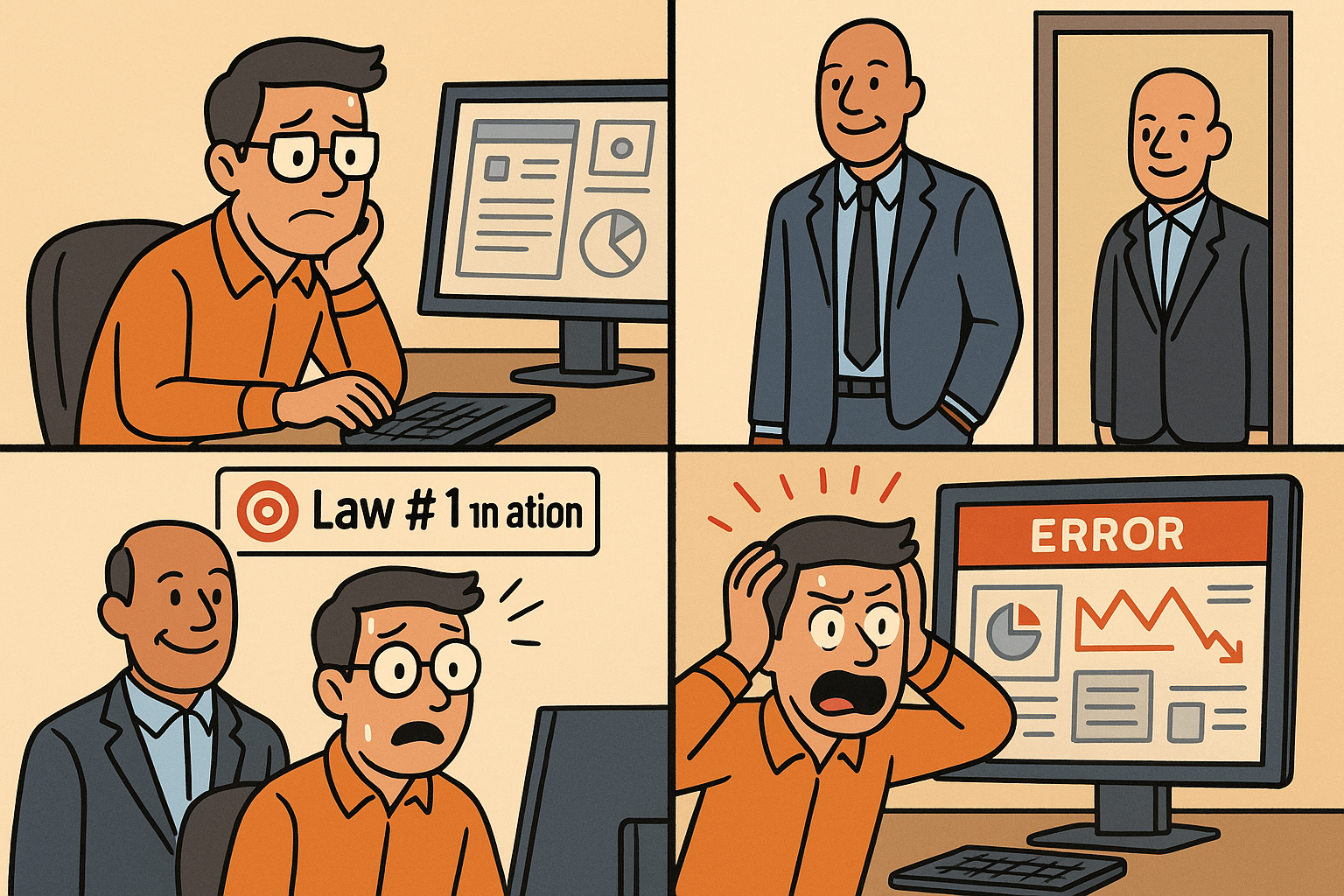
⚙️ Law #1: The Bug Only Appears When a VP Is Watching
You can test for weeks — staging, load, UAT, sandbox, pre-prod, even that one secret “just-in-case” environment you spun up on your personal account.
Everything’s fine.
Flawless.
Then demo day arrives.
VP joins.
Someone shares screen.
You click the “Show Insights” button — and boom.
The API times out.
The charts spin forever.
The VP leans forward, smiling politely, while you contemplate alternate careers.
This is not coincidence.
This is quantum bug observation theory:
A bug exists only when it detects human authority nearby.
It’s nature’s way of reminding us that confidence should always deploy behind a feature flag.
📜 Law #2: Logs Will Be Silent Until You Add More
You finally reproduce the bug in prod (after swearing it “should never happen”).
You open the logs.
Nothing.
You add more logs, redeploy, and—
like a magician revealing his trick—
the system starts working perfectly.
It’s not superstition; it’s software karma.
Bugs fear visibility.
They hide in the shadows of insufficient logging.
There’s a simple moral here:
log early, log often, log like your career depends on it.
Because someday it might.
🧨 Law #3: The Fix Will Break the Analytics Dashboard
After hours of heroic debugging, you identify the culprit — one innocent-looking null check.
You push the fix, monitor the pipeline, and breathe that sweet “all-green” relief.
Then someone from analytics messages:
“Hey, our metrics just flatlined since your last deploy.”
Turns out your fix changed an event name, removed a parameter, or accidentally “optimized away” the only field they needed.
Congratulations — you’ve just learned conservation of pain:
You can never destroy a bug. You can only transfer it to another system.
🧠 Lessons in Humility and Release Readiness
These three laws aren’t about pessimism — they’re about respect.
Respect for complexity.
Respect for the invisible forces that connect one line of code to an executive demo, a log parser, and a revenue dashboard.
Every seasoned engineer eventually learns:
- No design survives first contact with production.
- Perfection is less important than observability.
- And confidence without rollback is just optimism in disguise.
So next time a VP asks, “Is it stable?” —
say: “It’s stable enough to know when it’s unstable.”
That’s not cynicism. That’s experience.
💡 In production, humility scales better than code.